When did Ino Tadataka live?
Ino Tadataka was born in 1745 and died in 1818.
But before reaching for the dates, it helps to ask what kind of era he was actually living in. Commodore Perry arrived in 1853. Ino died 35 years earlier, in 1818. So he is not a “Bakumatsu figure” in the strict sense. He’s better understood as someone who lived in the late Edo period, just as the need for accurate maps was becoming more urgent — but before the dramatic events of the late shogunate.
What was the “late Edo period,” really?
It wasn’t an era of nationwide warfare like the Sengoku period. It also wasn’t an era of railways and telegraphs reuniting the country, like the Meiji period that came after. It was the in-between era, when towns and ports and villages and Edo were being slowly but firmly tied together.
Edo had grown into a vast consumer city, drawing in goods, rice, and sake from across the country. The river-trade town of Sawara — Ino’s home — prospered because it sat on the Tone River route into Edo. That wasn’t an accident. It was a sign that Japan was beginning to look less like a collection of separate places and more like a single economy.
So “late Edo” isn’t just a label on a textbook chapter. For Ino, it meant something specific: it was the era in which walking the country and measuring it could actually be useful to the country.
What did “a map” mean in his time?
Today we think of maps mostly as tools for travel or research. In Ino’s time, maps mattered more directly. First, they were a tool of logistics. Where are the ports? Where are the rivers? Where do goods move from, and to? You can’t run a wide country without that.
They were also a tool of coastal defense. According to the National Archives of Japan, after Adam Laxman arrived in 1792, the shogunate began strengthening administration and defense in Ezo, and after Russian raids in 1806–1807 the tension grew sharper. When Ino set out on his first survey in 1800, the question of foreign ships was no longer purely theoretical.
And they were a tool of governance. The Geospatial Information Authority of Japan describes how Ino’s surveying began as a private project but, after his maps were inspected by the shogun, became increasingly recognized as official work, with about 80% eventually carried out as a shogunate project. In other words, mapmaking became too important to leave to individual enthusiasm.
This is why the value of the Ino Map is not just “it was very accurate for its time.” It’s that it answered a real question of late-Edo Japan: how do we move our country, defend it, and understand its actual shape?
Why could Ino Tadataka travel all over Japan in the Edo period?
This is one of the easiest things to misunderstand. The Edo period wasn’t a time when nobody could move. People did travel — for pilgrimages, for trade, for official duties.
But Ino’s case was unusual. He could do what he did because he had built up, in Sawara, money, literacy, and local trust as a successful merchant. After moving to Edo and studying under Takahashi Yoshitoki, his surveying gradually became recognized as official work, which meant his long journeys were no longer a private hobby — they were a public job.
In short: he wasn’t able to travel “in spite of” the Edo period. He was able to travel because the conditions of late-Edo Japan, and his own preparation, lined up at the same time.
And then “1818, completed in 1821” finally makes sense
Ino died in 1818. The map was completed in 1821. Without context, that order can feel like a footnote.
But it isn’t. Because measuring Japan had become a real public need — not just one man’s obsession — the work was carried on by his disciples, and three years after his death, the Dai-Nihon Enkai Yochi Zenzu was completed.
So if someone asks “when did Ino Tadataka live?”, “1745 to 1818” isn’t quite enough on its own. The fuller answer is: a man of the late Edo period, when maps were becoming necessary not only to know the country but also to defend it and to move things through it.
Quick questions
When did he live?
Born 1745, died 1818 — late Edo, 35 years before Perry’s arrival in 1853.
How could he move freely in the Edo period?
Travel for pilgrimages, trade, and official duty did exist. Ino in particular had built up money, literacy, and local trust as a merchant in Sawara, and his surveying became an officially recognized shogunate project, so his long journeys were public work, not private travel.
When was the map completed?
After his death in 1818, his disciples carried the work forward and presented the completed map to the shogunate in 1821.
Related reading
- Why Is Ino Tadataka Famous? A Simple Guide to the Man Who Mapped Japan After 55
- How Old Was Ino Tadataka When He Started Surveying? Age 55, but the Turning Point Was 50
- What Is the Dai-Nihon Enkai Yochi Zenzu? The Formal Name of the Ino Map, Explained
- Who Was Ino Tadataka? The Edo Surveyor Who Restarted His Life at 50
- Ino Tadataka Timeline: From 1745 to the 1821 Ino Map in Five Periods
- Ino Tadataka’s Teacher and Disciples: The Network Behind the Ino Map
- Footscroll — walk with Ino Tadataka
References
- Geospatial Information Authority of Japan: Old Map Collection — the Ino Maps
- Geospatial Information Authority of Japan: Special Exhibition on the Ino Maps
- National Archives of Japan: Hokuidan
- National Archives of Japan: Kaibō Mondō
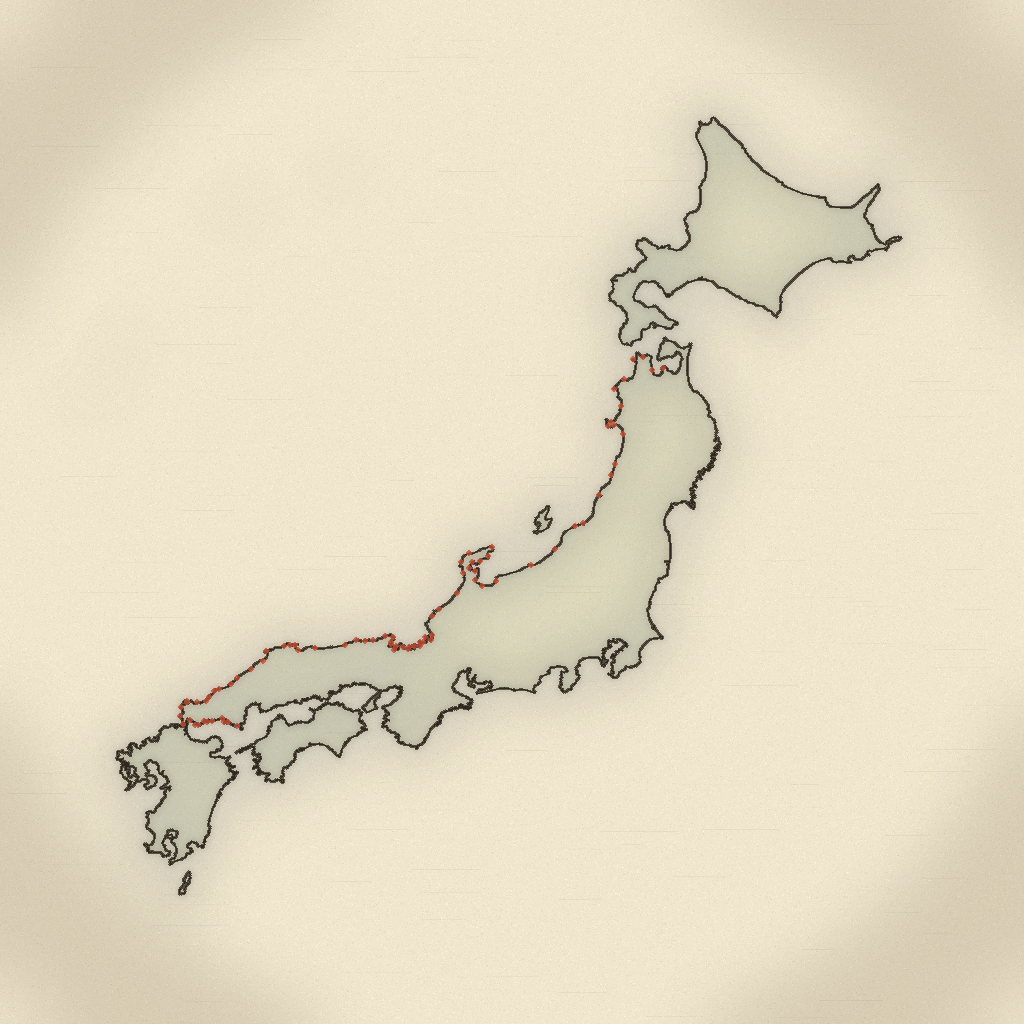
Footscroll
Walk Ino Tadataka's Journey With Your Own Steps
Footscroll turns your daily step count into a quiet journey across a washi-style map of Japan, inspired by Ino Tadataka's survey routes.