The answer is 55. But the turning point was 50.
Let’s start with the short answer. Ino Tadataka set out on his first nationwide survey at age 55, in 1800, when he traveled to Ezo (today’s Hokkaido) to begin measuring its coast.
But the more revealing moment came five years earlier. In 1795, at age 50, Ino left Sawara for Edo. He had not been a scholar of maps his whole life. He was a successful merchant from Sawara who, at fifty, decided to start over as a student. That is what makes Ino Tadataka memorable — and it’s where his story really begins.
Where was he from?
Ino was born in 1745 in Kozeki Village, Yamabe District, Kazusa Province — today’s Kozeki, Kujūkuri Town, Chiba Prefecture. He spent his youth around the area now called Yokoshibahikari. At 17, he was adopted into the Ino family of Sawara, Shimōsa Province as a son-in-law.
In other words, he wasn’t born in Edo. He was born in a coastal village, made his name as a merchant in the Tone River trading town of Sawara, and only later moved to Edo at 50.
In that order, the move at 50 looks different. He wasn’t a struggling provincial finally going to the capital. He was someone who had already built a household and a business in another place, then chose to start learning all over again.
What was he doing before Edo?
The first thing to understand is that Ino wasn’t a merchant in name only. According to the city of Katori, the Ino Sanjūrōemon family was one of the leading merchant houses in Sawara, and the family business was centered on sake brewing.
Sawara grew up as a hub of Tone River trade, connecting Edo with northeastern Japan. People and goods passed through it, and its commercial and cultural ties to Edo were close enough that the town later earned the nickname Edo-masari — “more Edo than Edo.” Ino lived right in the middle of that.
His former house, still preserved on the banks of the Ono River, isn’t a museum-style “great man’s home.” It’s an old merchant compound — main gate, storefront, accounting office, and storehouses, all opening onto the river. Ino lived there from age 17 to 49. That means by the time he turned to surveying, he already knew the practical world of shop, ledger, and village administration from the inside.
Was business going well?
Yes, by all accounts. The Geospatial Information Authority of Japan notes that when Ino joined the family by adoption, the business was not particularly prosperous, but it grew under his stewardship.
There’s a small story that captures what kind of merchant he was. According to the same source, when famine struck, he distributed food to people in need, and as a result he was granted the right to wear a sword by a shogunate official. So it wasn’t only money — he was also someone whose standing in his community was real.
Seen this way, the move to Edo at 50 carries even more weight. He wasn’t leaving town to escape hardship. He already had a comfortable position as a leading Sawara merchant — and he chose to set it down anyway, in order to start studying again.
So why move to Edo at 50?
This is the moment everything turns on. In 1795 (Kansei 7), Ino handed the family headship to his heir, retired from business, and moved to Edo at 50 to study under Takahashi Yoshitoki.
Sawara to Edo isn’t a forbidding distance — the towns were already linked by river trade, and it’s only about 69 km in a straight line to Nihonbashi. The hard part wasn’t the distance. It was what he was giving up, and what he was choosing instead. In Sawara, he already had a place as a leading merchant. He handed that place to his successor and became, at 50, a student.
And he didn’t pick up some gentle hobby. He took up calendar science, astronomy, and surveying — fields that were demanding even by the standards of the time. The reason this turning point is still talked about isn’t simply that he “tried hard in old age.” It’s that he was honest enough, and serious enough, to actually shift the center of his life from one career into another.
Why “55” is the famous number
Even so, the more famous number is 55. From the moment Ino set out for Ezo in 1800, his work shifts from private study into the practical job of measuring the actual shape of Japan. From that point on, the surveys gradually become recognized as a project of the shogunate.
So if someone asks for the search-engine answer, “55” is correct. But the moment that makes him human is the one before that. The surveying began at 55. The decision happened at 50, when he stopped being a Sawara merchant and walked into Edo.
Quick questions
How old was he when he started surveying?
His first nationwide survey began at 55, in 1800, when he set out to map the coast of Ezo (Hokkaido).
What happened at 50?
In 1795, he handed his business to his heir, left Sawara for Edo, and became a student of the astronomer Takahashi Yoshitoki. This is the direct turning point that led to surveying.
What was he doing before that?
He was a leading merchant in Sawara, in a family centered on sake brewing. Sawara was a major Tone River trade town with strong ties to Edo.
Can you really restart at 50?
In his case, yes — because he was building on what he’d already earned: money, literacy, and trust. His move wasn’t a desperate late start, it was a deliberate change of focus by someone who had already succeeded once.
Related reading
- Why Is Ino Tadataka Famous? A Simple Guide to the Man Who Mapped Japan After 55
- How Far Did Ino Tadataka Walk? Unpacking the 40,000-Kilometer Number
- How Accurate Was the Ino Map? Reading It as an Edo-Period Achievement
- Who Was Ino Tadataka? The Edo Surveyor Who Restarted His Life at 50
- Ino Tadataka Timeline: From 1745 to the 1821 Ino Map in Five Periods
- Ino Tadataka’s Teacher and Disciples: The Network Behind the Ino Map
- Footscroll — walk with Ino Tadataka
References
- Katori City: About Ino Tadataka
- Katori City: Footsteps of Ino Tadataka
- Geospatial Information Authority of Japan: Ino Tadataka
Footscroll
Walk Ino Tadataka's Journey With Your Own Steps
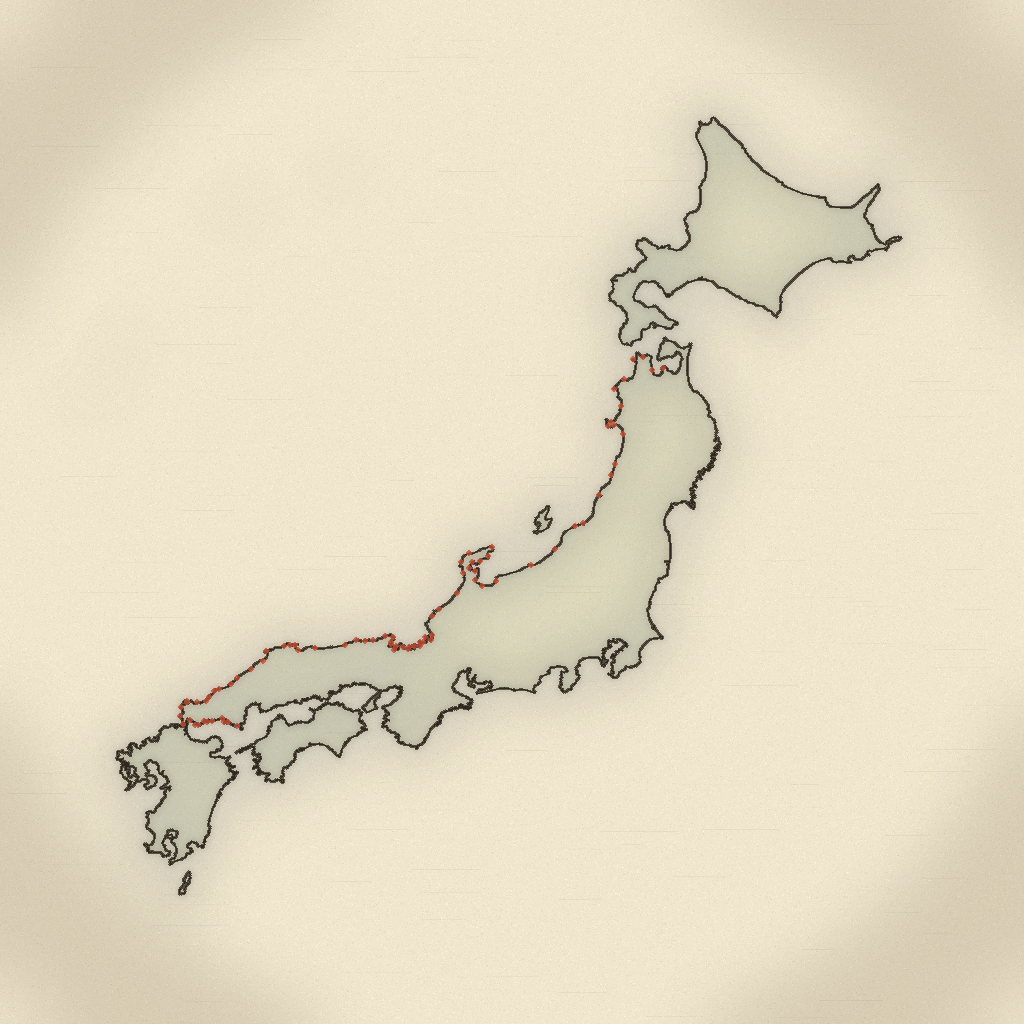
Footscroll turns your daily step count into a quiet journey across a washi-style map of Japan, inspired by Ino Tadataka's survey routes.