How did Ino Tadataka actually survey?
If you boil it down, Ino Tadataka’s surveying method was: walk to measure distance, take bearings to confirm direction, use astronomical observation to fix position, and then turn the records into a map.
There was no GPS in his time. He and his teams worked out the shape of Japan with their feet, their instruments, and their observations of the sky.
So Ino’s surveying wasn’t a journey of pure willpower. It was a practical fieldwork method that combined distance, direction, and astronomy.
The four steps, in plain terms
| Step | What it actually was | What it gave the map |
|---|---|---|
| Pacing | Walking with a steady stride to measure distance | How far you’ve gone |
| Bearing | Using a compass to record direction | Which way the line is pointing |
| Astronomical observation | Fixing position from the sky | A check on overall position |
| Mapping | Organizing the records into a map | The final shape of Japan |
If you search for “Ino Tadataka surveying method,” this is probably what you’re really asking about — the whole picture. His work wasn’t only walking, and it wasn’t only observation. It was the way the two were tied together.
Pacing wasn’t primitive — it was a way of producing distances
The most famous part of Ino Tadataka’s method is pacing, or hosoku: measuring distance by walking with a calibrated stride.
That sounds primitive at first. But Ino’s pacing wasn’t a guess. He kept his stride length consistent, recorded the steps along each route, and accumulated the measurements into a real backbone of distance.
In other words, pacing wasn’t a slogan about persistence. It was a practical way to turn “how far we walked” into a measurable number, given the conditions of the time.
For a quick feel of steps turning into distance, try Ino Tadataka Stepper. It is a browser mini game where left-right taps move a surveyor along the coastline.
Distance alone isn’t a map — you also need direction
Distance tells you how far. It doesn’t tell you which way. Without direction, you can’t draw a map.
That’s where bearing measurement comes in. By recording the direction of coastlines, roads, capes, and mountains, the team turned a stream of movements into a shape.
The reason Ino’s surveys can be read as maps, and not as travel diaries, is that direction is firmly built into the records.
What makes him distinctive: astronomical observation
Where Ino Tadataka really separates himself from a “long walk with notes” is the astronomical observation.
The Geospatial Information Authority of Japan describes how he studied astronomy and mathematical surveying, including work tied to measuring the size of the Earth. In other words, his surveying was never confined to the ground.
By observing the sun and stars from the ground, he could fix latitude — and that anchored the surveying records from above. This is what turned the work from a long travel log into a map with position data backed up from the sky.
So “he just walked” misses the point
The real strength of Ino Tadataka’s work isn’t that he walked a lot. It’s that he turned what he walked into information about position and direction, anchored by astronomical observation, and finally drawn as a map.
So the short answer to “how did Ino Tadataka survey?” is, in one sentence:
By walking to measure distance, taking bearings to record direction, using astronomical observation to fix position, and turning all of it into a map.
Quick questions
How did he survey?
By pacing out distances, taking bearings, observing the sky to fix position, and turning the records into a map.
What is pacing (hosoku)?
Measuring distance by walking with a calibrated, steady stride. It looks primitive, but it was a practical way of turning distance into numbers under the conditions of the early 1800s.
Why was astronomical observation needed?
Because distance and bearing measurements accumulate small errors over long stretches. Astronomical observation anchors latitude, which keeps the overall map honest.
Related reading
- How Accurate Was the Ino Map? Reading It as an Edo-Period Achievement
- What Is the Dai-Nihon Enkai Yochi Zenzu? The Formal Name of the Ino Map, Explained
- How Far Did Ino Tadataka Walk? Unpacking the 40,000-Kilometer Number
- Who Was Ino Tadataka? The Edo Surveyor Who Restarted His Life at 50
- Ino Tadataka’s Surveying Tools: The Equipment Behind 40,000 Kilometers
- Ino Tadataka Stepper — tap along Japan’s coastline
- Ino Tadataka Timeline: From 1745 to the 1821 Ino Map in Five Periods
- Footscroll — walk with Ino Tadataka
References
- Geospatial Information Authority of Japan: Ino Tadataka
- Geospatial Information Authority of Japan: Special Exhibition on the Ino Maps
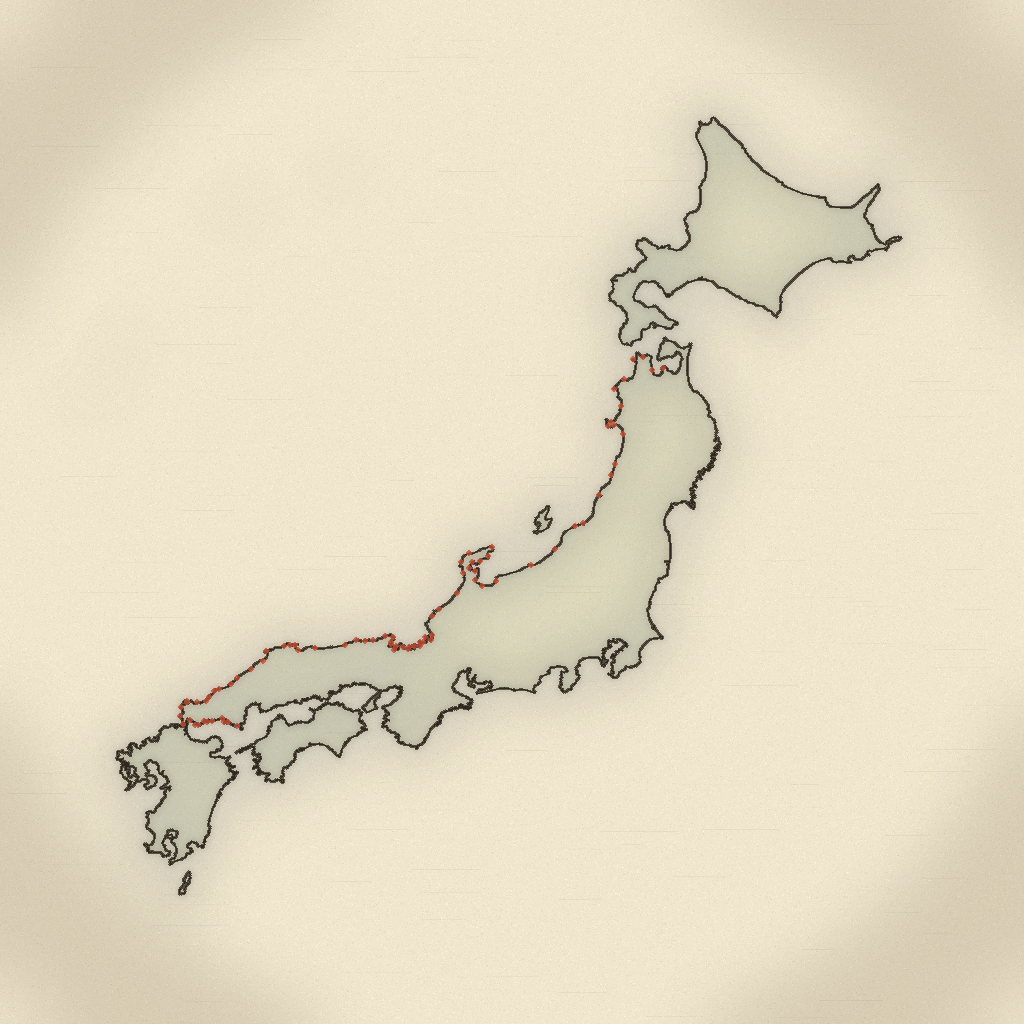
Footscroll
Walk Ino Tadataka's Journey With Your Own Steps
Footscroll turns your daily step count into a quiet journey across a washi-style map of Japan, inspired by Ino Tadataka's survey routes.