How far did Ino Tadataka walk?
Ino Tadataka is commonly said to have walked about 40,000 kilometers for his surveying work. On its own, that sounds like a piece of “great-man” trivia.
But the number gets much more vivid as soon as you unpack it. The Geospatial Information Authority of Japan describes him as someone who walked across Japan for nearly 20 years, covering more than the circumference of the Earth — and the deeper point is not just the scale. The deeper point is that he was measuring and recording the entire way, turning the journey into a map.
What 40,000 km actually means
“40,000 km” doesn’t fit easily in a human head. So here are some simple ways to break it down.
| Comparison | Rough number |
|---|---|
| Compared to the Earth’s circumference (about 40,075 km) | 99.8% |
| Averaged over 17 years | About 2,353 km per year |
| Then divided by 365 days | About 6.4 km per day |
These numbers don’t mean he walked exactly the same distance every day. The surveying expeditions included observation, recording, and travel days as well. So this table is a way to feel the scale, not a literal schedule.
Even so, once you realize that 40,000 km is almost exactly one trip around the Earth, and that it was done as part of a job, the impression changes a lot.
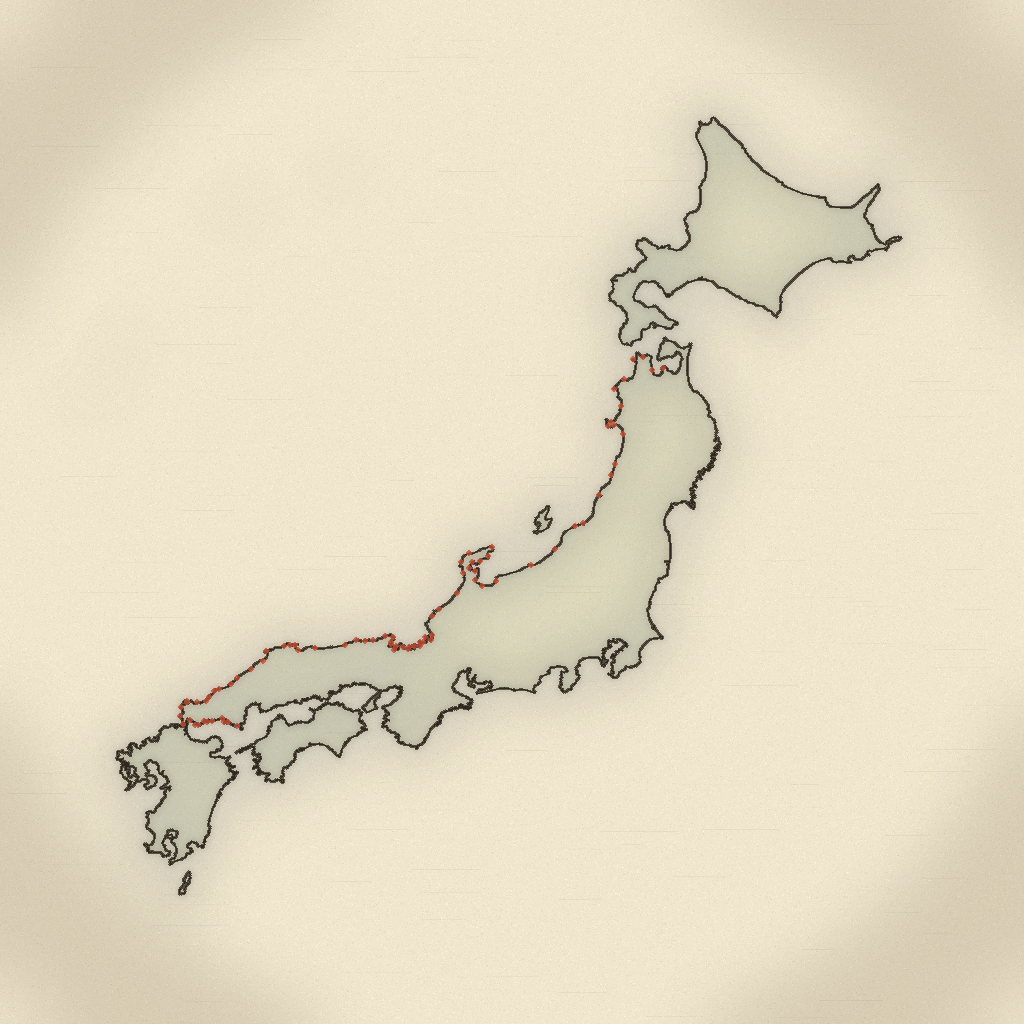
If you want to feel the distance first, try Ino Tadataka Stepper. It is a small browser game where tapping left and right moves a surveyor along Japan’s coastline while the steps and distance climb.
It wasn’t just a long walk
What Ino Tadataka was doing was not “walking” in the usual sense.
Following coastlines and roads, he measured distances, took bearings, observed the sky where needed, and organized the records. In other words, walking wasn’t the goal — it was the method for verifying the shape of Japan.
This is what makes it different from a normal journey.
What we now see in seconds on a map app, he had to gather with his own feet and instruments. So the 40,000-kilometer figure isn’t only about stamina. It carries with it the density of the surveying work itself.
The interesting part is the persistence, not the spectacle
If you only remember Ino as “the guy who walked the circumference of the Earth,” you stop too early.
- He didn’t do it in one push.
- It was split across many surveying expeditions.
- And on every single one, he was measuring and recording.
Looked at this way, 40,000 km is not a flashy headline number. It’s the result of sustaining accuracy over a very long stretch of time. The most striking thing isn’t the size of the distance — it’s the steadiness underneath it.
The one-line answer
About 40,000 km. Almost the circumference of the Earth. Walked over 17 years for the sake of surveying.
That sentence is enough as a short answer. But the real interest is that the distance carries with it all the measuring, observing, and recording that turned the walking into a map.
Quick questions
How far did he walk?
His surveying journeys are commonly described as totaling about 40,000 km — roughly the circumference of the Earth (about 40,075 km).
How many kilometers a day?
Averaged over 17 years, about 2,353 km per year, or about 6.4 km per day. He wasn’t actually walking every day; observation, recording, and travel days are folded into the total.
Was he just walking a long way?
No. Walking was the method, not the goal. Every step was tied to measuring distance, taking bearings, observing the sky, and turning the records into a map.
Related reading
- Why Is Ino Tadataka Famous? A Simple Guide to the Man Who Mapped Japan After 55
- How Old Was Ino Tadataka When He Started Surveying? Age 55, but the Turning Point Was 50
- How Accurate Was the Ino Map? Reading It as an Edo-Period Achievement
- Who Was Ino Tadataka? The Edo Surveyor Who Restarted His Life at 50
- Ino Tadataka Timeline: From 1745 to the 1821 Ino Map in Five Periods
- Ino Tadataka’s Surveying Tools: The Equipment Behind 40,000 Kilometers
- Ino Tadataka Stepper — tap along Japan’s coastline
- Footscroll — walk with Ino Tadataka
References
Footscroll
Walk Ino Tadataka's Journey With Your Own Steps
Footscroll turns your daily step count into a quiet journey across a washi-style map of Japan, inspired by Ino Tadataka's survey routes.