Ino Tadataka’s life at a glance
Ino Tadataka lived for 74 years, and across that time he changed direction several times — merchant → late-life student → nationwide surveyor → editor of the final map. Listing dates and numbers alone makes the story hard to read, so this page is organized into five periods.
First the full timeline, then the periods, and finally an age-by-age quick reference.
Full timeline
| Year | Era | Age | Event |
|---|---|---|---|
| 1745 | Enkyō 2 | 0 | Born in Kozeki Village, Yamabe District, Kazusa Province (today’s Kujūkuri Town, Chiba) |
| 1762 | Hōreki 12 | 17 | Adopted into the Ino family of Sawara, Shimōsa Province (today’s Katori City, Chiba) |
| 1781 | Tenmei 1 | 36 | Appointed village head; runs the family business while serving as a local official |
| 1783 | Tenmei 3 | 38 | Tenmei Famine. Distributes rice to people in need, gaining strong local trust |
| 1794 | Kansei 6 | 49 | Begins preparing for retirement |
| 1795 | Kansei 7 | 50 | Hands the family headship to his adopted heir Kagetaka, moves to Edo, and becomes a student of Takahashi Yoshitoki |
| 1800 | Kansei 12 | 55 | First survey (south coast of Ezo) |
| 1801 | Kyōwa 1 | 56 | Second survey (Izu and the Pacific coast of eastern Japan) |
| 1802 | Kyōwa 2 | 57 | Third survey (Sea of Japan coast of Tōhoku) |
| 1803 | Kyōwa 3 | 58 | Fourth survey (Tōkai and Hokuriku) |
| 1804 | Bunka 1 | 59 | Map shown to the shogun in Edo. From this point, the surveys are increasingly recognized as official shogunate work |
| 1805 | Bunka 2 | 60 | Fifth survey (Kinki and Chūgoku) |
| 1808 | Bunka 5 | 63 | Sixth survey (Shikoku) |
| 1809 | Bunka 6 | 64 | Seventh survey (Kyūshū, first part) |
| 1811 | Bunka 8 | 66 | Eighth survey (Kyūshū, second part) |
| 1815 | Bunka 12 | 70 | Ninth survey (the Izu Islands) |
| 1816 | Bunka 13 | 71 | Tenth survey (within the city of Edo). The nationwide surveying is now complete |
| 1818 | Bunsei 1 | 73 | Dies in Edo. His death is concealed for a time so that the map work can continue |
| 1821 | Bunsei 4 | (3 years posthumous) | The Dai-Nihon Enkai Yochi Zenzu is completed and presented to the shogunate |
Five periods
Period 1: Merchant years (1745–1794, ages 0–49)
For most of his life, Ino Tadataka was a merchant, not a surveyor. At 17 he was adopted into the Ino family of Sawara and gradually rebuilt the family’s sake-brewing business.
Sawara was a thriving river-trade town on the Tone River, with strong commercial and cultural ties to Edo — close enough that it later earned the nickname Edo-masari, “more Edo than Edo.” Ino ran his store, served as a village head, and during the Tenmei Famine distributed rice to those in need. By 49, he was an established figure with real local trust.
What matters here is that by the time he turned to scholarship, he had already lived a complete first life. His move at 50 wasn’t a desperate fresh start. It was a deliberate step away from a life that had already succeeded.
Period 2: Late-life student years (1795–1799, ages 50–54)
In 1795, at 50, Ino handed the family headship to his adopted heir Kagetaka and left Sawara for Edo. He settled in Fukagawa Kuroe-chō and became a student of Takahashi Yoshitoki, then an astronomer to the shogunate. Yoshitoki was 19 years younger than him — but Ino, with no apparent embarrassment, became his serious, full-time pupil.
These five years don’t have flashy events. But this is where the observational techniques, the methods for taking latitude and longitude, and the basic surveying procedure that would later support the nationwide work were quietly assembled.
Period 3: Nationwide surveying years (1800–1816, ages 55–71)
In 1800, at 55, Ino set out on his first survey, to the south coast of Ezo. At first the project was almost a private one. But after his maps were inspected by the shogun in 1804, the surveys became increasingly recognized as official shogunate work.
Over the next 17 years, his teams completed ten major surveys: Ezo, the Pacific coast of eastern Japan, the Sea of Japan coast of Tōhoku, Tōkai and Hokuriku, Kinki and Chūgoku, Shikoku, Kyūshū (twice), the Izu Islands, and finally the city of Edo. The total distance walked is commonly described as about 40,000 km — almost the circumference of the Earth.
Period 4: The editing years (1816–1818, ages 71–73)
In 1816 the tenth survey was finished and Ino returned to Edo for good. The remaining time was spent turning the survey records into map form. In 1818, at 73, he died in Edo without seeing the map completed.
Period 5: The disciples finish the work (1818–1821)
This is the most distinctive part of the story. Ino’s death was kept quiet for a time, and his disciples continued the editing work. In 1821, three years after his death, the Dai-Nihon Enkai Yochi Zenzu was finally completed and presented to the shogunate.
In other words, the Ino Map isn’t the work of one man. It’s a project centered on Ino, but ultimately carried across the finish line by his disciples after his death. As an ending to a timeline, that’s quietly powerful.
At a glance: what happened at what age
| Age | What happened |
|---|---|
| 17 | Adopted into the Ino family of Sawara |
| 38 | Distributes rice during the Tenmei Famine |
| 50 | Hands over the family business, moves to Edo, becomes Takahashi Yoshitoki’s student |
| 55 | First nationwide survey (south coast of Ezo) |
| 59 | Maps shown to the shogun; surveys become an official project |
| 71 | Tenth survey completed; the nationwide surveying is finished |
| 73 | Dies in Edo |
| (3 years posthumous) | Dai-Nihon Enkai Yochi Zenzu completed |
Quick questions
When was he born and when did he die?
Born 1745 in Kozeki Village, Yamabe District, Kazusa Province; died 1818 in Edo at 73.
At what age did he hand over the family business?
At 50, in 1795. He passed the headship to his adopted heir Kagetaka, left Sawara, and became a student of Takahashi Yoshitoki in Edo.
At what age did he start his first survey?
At 55, in 1800. The first survey was the south coast of Ezo, and over the next 17 years he ran ten major surveys across Japan.
When was the Ino Map completed?
In 1821, three years after his death. His disciples carried the work forward and presented the completed map to the shogunate.
Related reading
- Who Was Ino Tadataka? The Edo Surveyor Who Restarted His Life at 50
- Why Is Ino Tadataka Famous? A Simple Guide to the Man Who Mapped Japan After 55
- How Old Was Ino Tadataka When He Started Surveying? Age 55, but the Turning Point Was 50
- When Did Ino Tadataka Live? The Late-Edo Surveyor Who Died 35 Years Before Perry
- What Is the Dai-Nihon Enkai Yochi Zenzu? The Formal Name of the Ino Map, Explained
- Footscroll — walk with Ino Tadataka
References
- Geospatial Information Authority of Japan: Ino Tadataka
- Geospatial Information Authority of Japan: Old Map Collection — the Ino Maps
- Katori City: About Ino Tadataka
- Katori City: Footsteps of Ino Tadataka
Footscroll
Walk Ino Tadataka's Journey With Your Own Steps
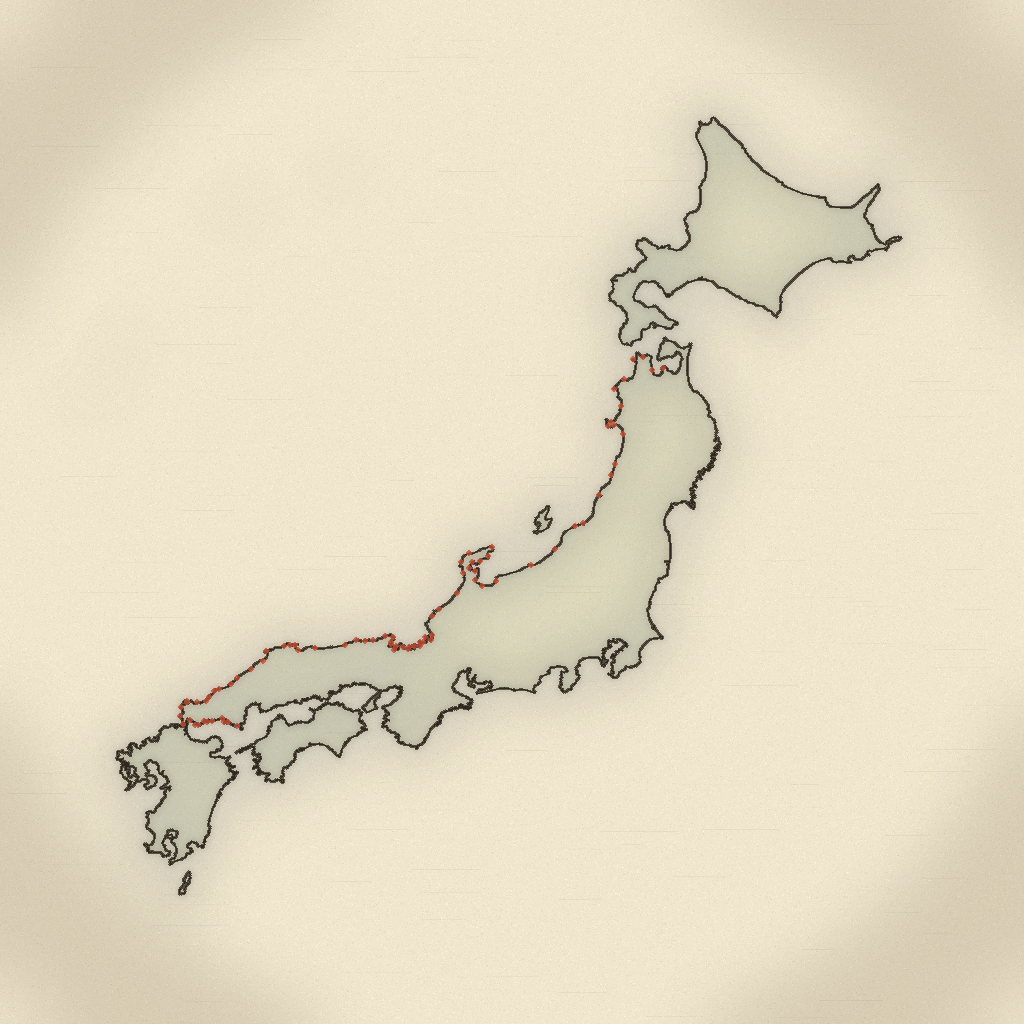
Footscroll turns your daily step count into a quiet journey across a washi-style map of Japan, inspired by Ino Tadataka's survey routes.