The people around Ino Tadataka
The story of Ino Tadataka doesn’t fit well as a story of lone genius. In front of him there was a teacher; beside him there were collaborators; behind him there were disciples who carried his work forward. It was that three-sided network that made a project the scale of a nationwide survey possible.
This page organizes the teacher, collaborators, and disciples around Ino.
His teacher: Takahashi Yoshitoki
The most important person in Ino Tadataka’s life was Takahashi Yoshitoki, his teacher.
Yoshitoki was an astronomer to the shogunate who led the Kansei calendar reform. What’s striking is that when Ino arrived in Edo in 1795, Yoshitoki was 31 and Ino was 50 — the teacher was 19 years younger.
In most circumstances that would be an awkward dynamic. But Ino didn’t let it bother him. He settled in Fukagawa Kuroe-chō, went to Yoshitoki regularly, and for five years studied observation and calculation as a serious student.
Yoshitoki died young, at 41, in 1804, before he could see the nationwide surveying completed. Even so, the five years Ino spent as his student were the direct foundation of the Ino Map. The first step of the Ino Map was built out of the age-crossing teacher-student relationship between Ino and Yoshitoki.
His collaborator: Mamiya Rinzō
One of the names most often paired with Ino Tadataka in history books is Mamiya Rinzō — generally known as the man who discovered the Mamiya Strait (the strait between Sakhalin and the Eurasian continent).
Rinzō’s connection with Ino came through the first Ezo survey. At the time, Rinzō was working as a shogunate official in Ezo and assisted with Ino’s surveying work.
To call him simply “one of Ino’s disciples” may be a little too simple, though. Rinzō went on independently to explore Sakhalin and confirm it was an island — a major piece of exploration work entirely separate from Ino’s project. He’s better understood as someone who worked alongside Ino while also forging his own distinctive path.
Even so, the records showing his involvement in Ino’s Ezo survey make him an important part of the human network that supported the northern edge of the Ino Map.
His disciples: the people who finished the map
What makes Ino Tadataka’s story particularly distinctive is that he died before his map was finished. In 1818, at 73, he died in Edo while the editing work was still ongoing.
But the project didn’t stop there. Ino’s death was quietly concealed for a time, and his disciples continued the editing work. The central figure was Takahashi Kageyasu — the son of Ino’s own teacher, Takahashi Yoshitoki — who had followed his father into the shogunate’s astronomical office and now took charge of bringing the map project to completion.
In 1821, three years after Ino’s death, the Dai-Nihon Enkai Yochi Zenzu was completed and presented to the shogunate.
So the Ino Map is not the work of one man. It’s a project that Ino centered on, but that was ultimately carried across the finish line by his disciples after his death — including a man whose father had first taught Ino how to survey.
Three sides of the network
| Role | Person | What they contributed |
|---|---|---|
| Teacher | Takahashi Yoshitoki | Received Ino as a student at 50; taught astronomy, calendar science, and surveying over five years |
| Collaborator | Mamiya Rinzō | Assisted with the Ezo survey; later explored Sakhalin independently |
| Disciple (teacher’s son) | Takahashi Kageyasu | Led the map editing after Ino’s death; completed the work in 1821 |
| Field teams | Surveying party members | Walked the country and supported measurement and observation on the ground |
Seen this way, Ino Tadataka’s story reads less as “one brilliant person” and more as “a project completed through people and system”. That’s part of why it keeps coming up in conversations about management, succession, and how large work gets done.
Quick questions
Who was his teacher?
Takahashi Yoshitoki, an astronomer to the shogunate. When Ino arrived in Edo at 50, Yoshitoki was 31 — 19 years younger. Ino studied under him for five years.
What was the relationship with Mamiya Rinzō?
Rinzō assisted Ino during the first Ezo survey and was one of Ino’s disciples. He later explored Sakhalin independently, confirming it was an island — the discovery for which the Mamiya Strait is named.
Who finished the map after Ino’s death?
Takahashi Kageyasu and other disciples. Kageyasu was the son of Ino’s teacher Takahashi Yoshitoki. After Ino died in 1818, they continued the editing and presented the completed map to the shogunate in 1821.
Related reading
- Who Was Ino Tadataka? The Edo Surveyor Who Restarted His Life at 50
- Ino Tadataka Timeline: From 1745 to the 1821 Ino Map in Five Periods
- How Old Was Ino Tadataka When He Started Surveying? Age 55, but the Turning Point Was 50
- What Is the Dai-Nihon Enkai Yochi Zenzu? The Formal Name of the Ino Map, Explained
- Footscroll — walk with Ino Tadataka
References
- Geospatial Information Authority of Japan: Ino Tadataka
- Geospatial Information Authority of Japan: Old Map Collection — the Ino Maps
- Katori City: About Ino Tadataka
Footscroll
Walk Ino Tadataka's Journey With Your Own Steps
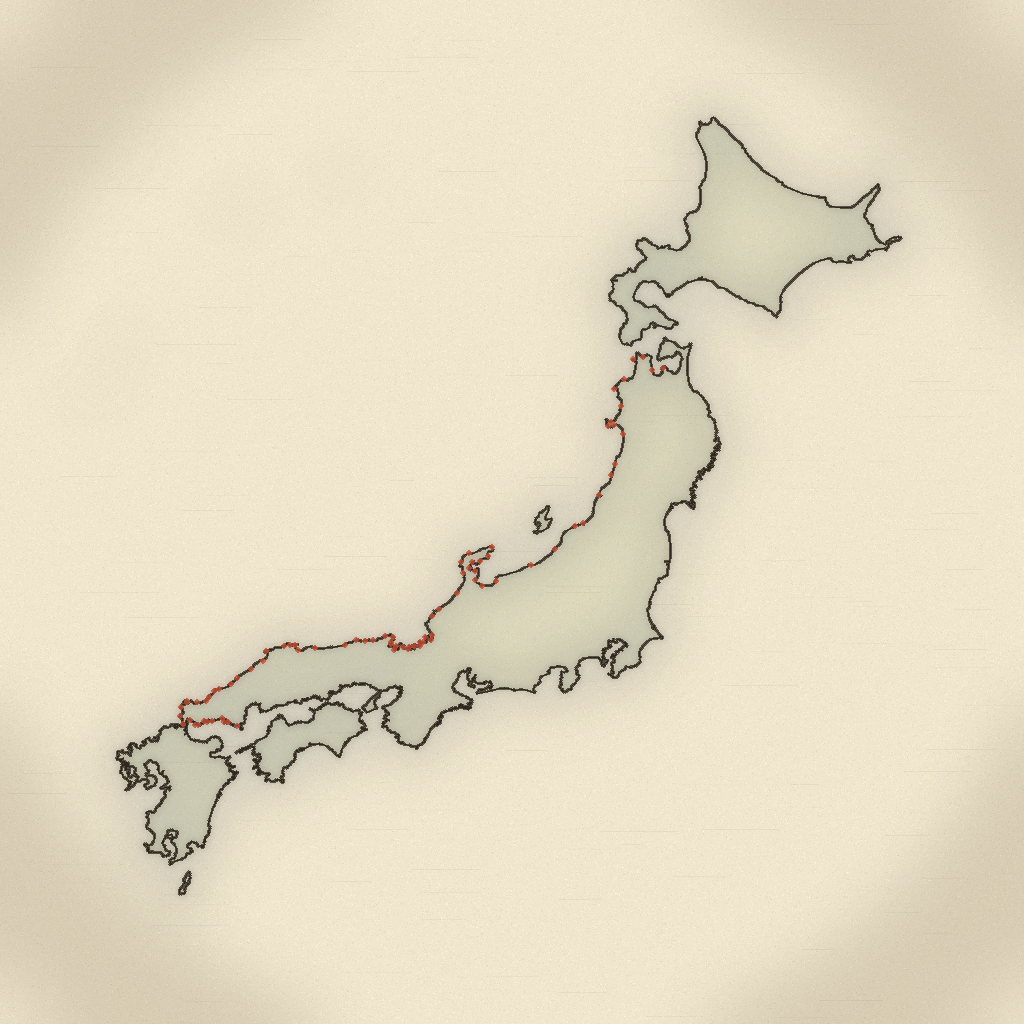
Footscroll turns your daily step count into a quiet journey across a washi-style map of Japan, inspired by Ino Tadataka's survey routes.