A collection of Japanese scenes, one poem at a time.
A hut beside an autumn rice field. White robes hanging against a mountain. Maple leaves drifting down a river.
In UdeTancho’s Waka collection, each Hyakunin Isshu poem has an illustration inspired by the scene its words suggest. The poem and its author’s name remain on the card, while the picture gives you somewhere to begin.
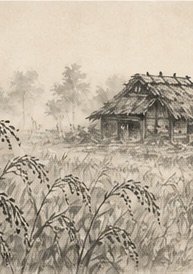
Emperor Tenji
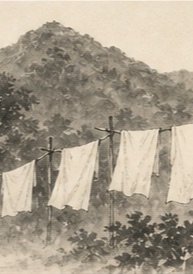
Empress Jito
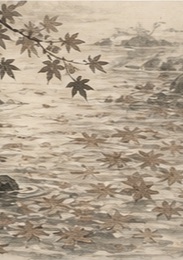
Ariwara no Narihira
Illustrations used in the app's poem cards.
New to the collection itself? Start with What Is Hyakunin Isshu? A First Guide to Japan’s Hundred Poems.
Discover Japanese poetry through its landscapes
Hyakunin Isshu is a collection of one hundred Japanese poems by one hundred poets. On traditional karuta reading cards widely used in Japan, the illustrations usually depict the poets in traditional dress.
Those portraits are part of the cards’ charm. But if you are encountering Japanese poetry for the first time, an unfamiliar face and name may not give you much to connect with yet. We wanted to offer another starting point, especially for people outside Japan.
You do not need to know Emperor Tenji to picture a rice field and a weathered hut. You do not need to know Empress Jito to notice the white of robes hanging in the breeze.
Japanese fields, mountains, rivers, and glimpses of everyday life offer a way into the poems. As the cards accumulate, they become a small collection of scenes to return to.
First, a picture catches your eye. Then you wonder what the poem says. That is the path we hoped these cards could open. It can also offer a fresh way to look at a poem you already know by heart.
Three poems, three scenes
Making each illustration meant choosing what to bring forward from the poem. Here is how we approached the three images above.
An autumn field and a humble hut
For Emperor Tenji’s poem, we pictured rice plants with a rough-roofed hut beyond them. The poem speaks of sleeves growing wet with dew. By giving the hut a place in the landscape, we wanted to make it easier to imagine standing there, close to the field.
White robes and the change of seasons
For Empress Jito’s poem, white robes hang against a mountain. Their pale shapes stand out from the soft ink tones around them. The image offers a way to linger over the poem’s passage from spring into summer.
A river carrying autumn leaves
For Ariwara no Narihira’s poem, we focused on maple leaves and flowing water. The poem evokes a deep crimson, but the illustration uses ink and sepia rather than filling the river with bright red. The words can supply the color in your imagination. We wanted to leave room for that, too.
These pictures are interpretations of the poems, not reconstructions of exactly what their authors saw. They reflect the scenes and feelings that mikocode found in the words.
From a picture to a poem’s meaning
An illustration cannot explain every layer of a waka. A landscape in a love poem may carry the feeling of waiting, separation, or a long night.
When you complete a poem in UdeTancho, you can read its translation, commentary, and background. These reading materials are available in Japanese and English.
You might begin with “I like this picture,” then discover a feeling you recognize in the poem. Moving between the image and the words is part of the pleasure of collecting the cards.
Your practice becomes your collection
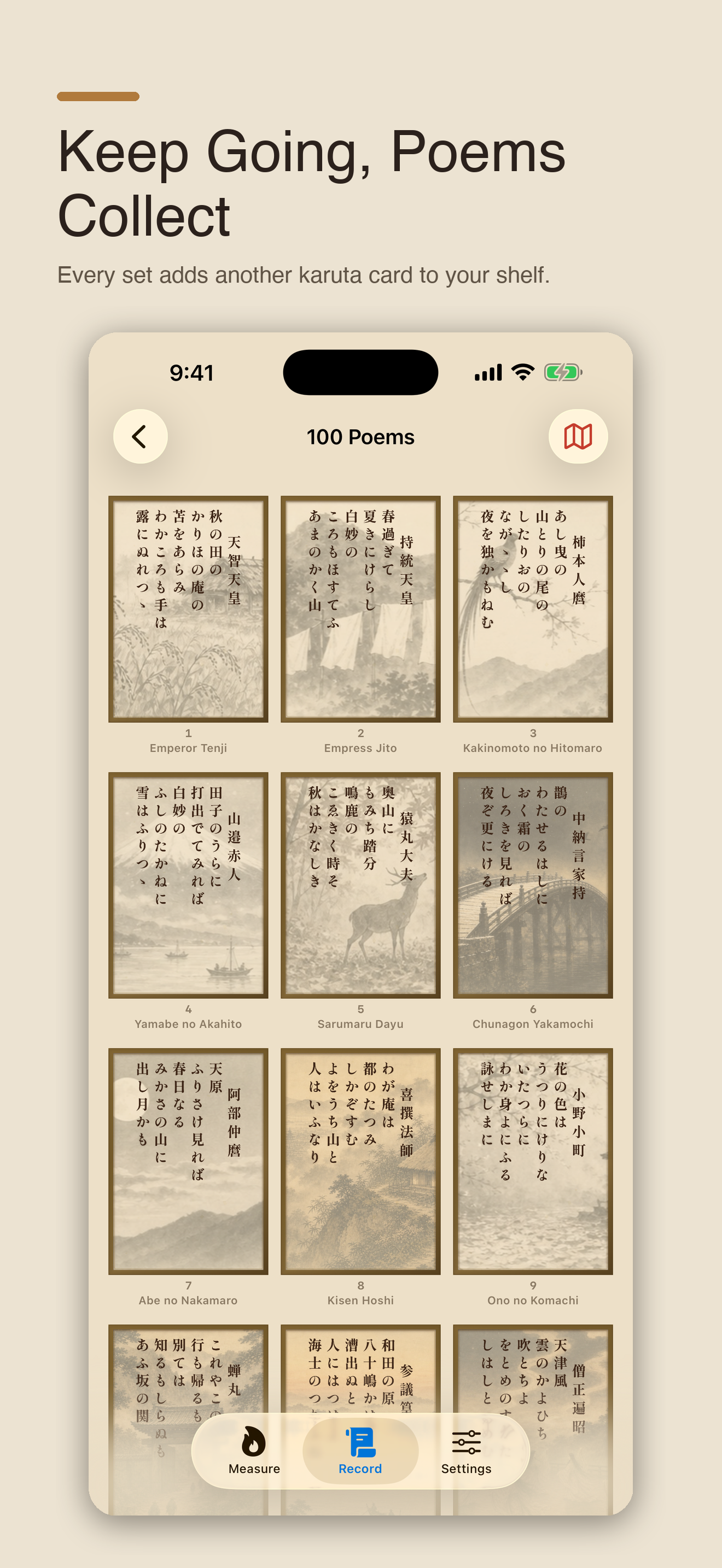
UdeTancho is an iPhone app that counts push-ups with the front camera. Each push-up adds one character to your poem progress. Completing a poem adds another finished card to your collection.
Your exercise leaves something you can return to and enjoy looking at. There is no need to collect everything at once: move at your own pace, and let the hundred poems become familiar a little at a time.
See the card collection in the app
Poetry you can approach through a picture
Interpreting poems through images has a history of its own. The Japan Playing Card Museum’s account of the Yoshida family’s Hyakunin Isshu cards describes surviving cards that illustrate the poems’ meaning without portraits of their authors.
What matters to us is bringing that pleasure into everyday life: a little movement, a picture to discover, and a poem you may want to know better. Wherever you are encountering Hyakunin Isshu, we hope a scene will give you a welcoming place to start.
The illustrations shown here are used in the app and were created with the help of generative AI.
For another look at our approach to Japanese scenery, read about creating a sense of stillness in Wakeikoku. For app use and device questions, see the UdeTancho FAQ.
UdeTancho
Collect a scene, one push-up at a time
Explore the push-up counter and its collection of illustrated Japanese poems.