Hyakunin Isshu is a collection of one hundred short Japanese poems, with one poem by each of one hundred poets. You can read it as poetry, encounter it in a card game, or begin with a single scene that catches your eye.
You do not need to know Japanese history—or read Japanese—to start exploring it in translation. Here are the few things that make a first encounter easier.
What does the name mean?
Hyakunin means “one hundred people”; isshu means “one poem.” The title describes the collection’s arrangement: a hundred different voices, represented by one poem each.
The best-known collection is Ogura Hyakunin Isshu, associated with the poet and critic Fujiwara no Teika and compiled in the thirteenth century. Teika selected poems by different authors; he did not write all hundred himself. The precise circumstances of compilation are a subject of scholarly discussion. Japan’s National Diet Library discusses that history (Japanese).
The poems themselves span the seventh to thirteenth centuries. Think of an anthology bringing together voices from several centuries, rather than a book written at one moment. The Japan Foundation’s introduction gives this time span.
What is a waka? Is it a haiku?
The poems in this collection use the short form now commonly called tanka. You will also see them called waka, a broader term for Japanese poetry.
Their basic rhythm has five units: 5–7–5–7–7. The Japanese sound units are often explained in English as syllables, though they are more precisely called morae: short timing units that do not always match English syllables. You do not need to count them to enjoy a translation.
If you have met haiku, you may recognize the opening 5–7–5 pattern. These poems have another 7–7 after it. English translations may use five lines, but do not have to reproduce the Japanese count. The Poetry Foundation introduces the tanka form and its relationship to haiku.
What are the poems about?
Love, waiting, parting, the seasons, and memories all appear. Some poems offer a vivid outdoor scene; others give us a feeling that is difficult to say directly.
For a first example, take poem 77, attributed to Emperor Sutoku. It describes a fast stream divided by a rock, then connects that image with a wish to meet again after separation. In our plain-language paraphrase:
Like water divided by a rock, we may part now—but I hope we will meet again.
This is an explanation of the image, not a line-by-line translation. You can find the Japanese poem in the Japan Foundation’s guide, under poem 77.
You can approach it in two steps: first, notice what the water does; then consider why someone longing for another person might choose that image. A landscape can carry a feeling as well as describe a place.
Why do people talk about cards?
Imagine cards spread face up on the floor. One person reads a poem aloud, and the other players race to touch the card containing its ending. Listening, recognizing the poem, and finding the right card are the heart of the game.
In Japan, this kind of poetry card game is called uta-garuta. It is one form of karuta, a broader name for Japanese card games. The Hyakunin Isshu poems became the basis for a widely played version.
A standard set has two groups:
- Reading cards (yomifuda): the complete poem, usually with a portrait of its poet.
- Taking cards (torifuda): only the poem’s final 7–7 portion.
Knowing a poem’s beginning helps you find the card with its ending before the reader reaches those words. The Japan Foundation’s illustrated instructions explain a casual version you can try.
Competitive karuta has its own rules. Two players begin with 25 taking cards each, and the aim is to empty your own side first. That is different from simply collecting the most cards in a casual game. The All Japan Karuta Association explains competitive play (Japanese).
You can enjoy the poems without playing, and you can enjoy the game while gradually learning their meaning.
Where should a complete beginner start?
Choose one poem, rather than treating all hundred as a memorization assignment.
- Read a short translation or explanation.
- Notice one concrete detail: a river, an autumn evening, a sleeve, the moon.
- Ask what feeling that detail might carry.
- If you are curious, look up the poet or listen to the Japanese recitation.
Names, old spellings, and references can wait until you want to know more. A first reading does not have to reveal everything.
Another entrance: the scenery in the poems
In UdeTancho, we illustrate scenes suggested by the poems, with the poem and poet’s name alongside them. The pictures offer an entrance into Japanese landscapes and seasons, even when the people and places are new to you.
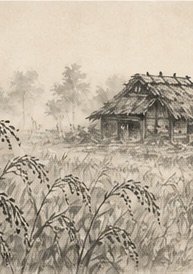
Emperor Tenji
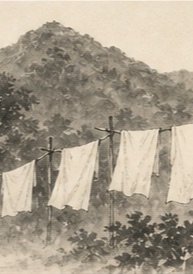
Empress Jito
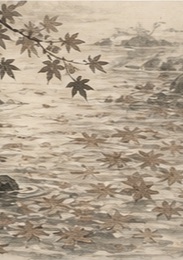
Ariwara no Narihira
Illustrations used in the app's poem cards.
The illustrations are not historical reconstructions. We explain the choices behind these three illustrations in Collect Japanese Landscapes, One Poem at a Time.
If you enjoy combining discovery with a small daily routine, UdeTancho connects push-up progress with collecting illustrated poems and reading their English explanations. For now, finding one poem you want to return to is already a good beginning.
UdeTancho
Collect a scene, one push-up at a time
Explore the push-up counter and its collection of illustrated Japanese poems.