“Make 10” is a rule you understand instantly
Pick a few numbers. If they add up to 10, you clear them.
That is almost the whole rule, yet it can be surprisingly hard to stop playing.
1 + 92 + 83 + 74 + 65 + 51 + 2 + 7
Some answers appear immediately. Others appear after one more look. That creates a quick rhythm: “I found it” followed by “there must be another one.”
That rhythm is the satisfying core of make-10 games.
If you want to try it first, play the tiny browser game Make 10 Sprint. It runs for 30 seconds and does not require an install.
Ten already feels like completion
Ten is more than just another number in everyday life.
We often use it as a natural boundary:
- a score out of 10
- a set of 10 reps
- a 10-step rating
- a top 10 list
Reaching 10 feels like completing a small unit.
That feeling comes partly from living inside base 10, and partly from the body-based habit of counting on two hands. I wrote more about that in Why Do Humans Use Base 10?.
A make-10 game turns that completion feeling into a tiny repeatable action.
Simple arithmetic, changing patterns
Make-10 games are not fun because the arithmetic is difficult.
The math is intentionally simple.
But once numbers are arranged on a board, the pattern changes every moment.
The same total can be made in many ways:
- take the obvious two-number pair
- connect three or more numbers
- wait for a better combination
The addition is easy. The search is the game.
That balance is why make-10 puzzles work so well as short, lightweight play.
In 30 seconds, addition becomes pattern recognition
Slow arithmetic and game arithmetic feel different.
When you try to make 10 repeatedly under a timer, the pairs start appearing almost automatically.
- If you see 8, you look for 2
- If you see 7, you look for 3
- If you see 6 and 1, you start looking for 3
It becomes less like studying and more like spotting shapes.
That makes the format approachable for both children and adults. The player is practicing number sense, but the experience still feels like play.
Tashitama turns that feeling into a falling puzzle
Make 10 Sprint is a small browser version of the core idea: make 10 quickly and enjoy the tiny snap of completion.
Tashitama takes that feeling further and turns it into a falling-number puzzle.
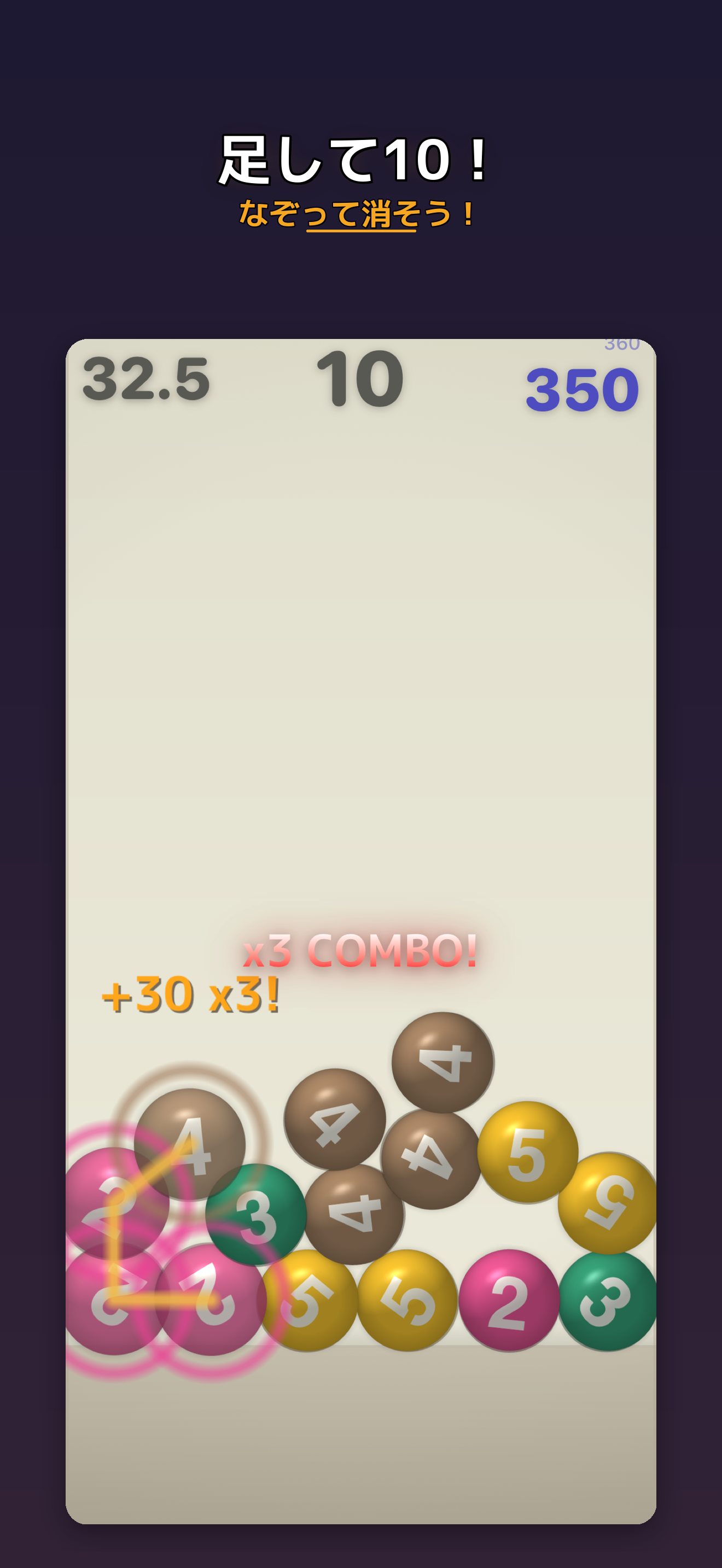
In Tashitama, you trace falling numbered balls and clear them by making totals of 10.
One clear feels good. Then new balls fall in, another 10 appears, and the rhythm begins to feel like a chain. That is where the falling-puzzle side of the game comes alive.
Summary
Make-10 games are satisfying because several things line up at once:
- 10 already feels like completion
- the rule is instantly understandable
- each board changes the search
- small wins arrive quickly
That is why a simple addition puzzle can feel so good.
Try Make 10 Sprint for 30 seconds. If you want a fuller puzzle built around that same feeling, visit Tashitama.
Tashitama
Turn the feeling of making 10 into a puzzle.
Tashitama is a quick number puzzle where you trace falling balls, make totals of 10, and chase satisfying chain combos.