Why do falling puzzle games feel so good?
Something falls from the top of the screen.
You look.
You decide.
You place, match, or trace.
Something clears.
The next piece arrives.
That loop has powered some of the most enduring puzzle games ever made.
In Japanese, people often call this broad family ochige or ochimono puzzle: falling puzzle games. In English, the closest term is usually falling block puzzle games, though the family has grown beyond literal blocks.
But why is the pattern so strong?
And where did it begin?
To answer that, it helps to walk through Tetris, Columns, Dr. Mario, Puyo Puyo, and then the number-puzzle branch that leads toward Tashitama.
Tetris is still the center of the story
Any history of falling puzzle games has to begin with Tetris.
Tetris was created in 1984 by Alexey Pajitnov, a computer programmer in Moscow. The game uses falling tetrominoes: geometric pieces made from four squares. Players rotate and arrange them to complete horizontal lines, and completed lines disappear.
The rules are short. The depth is enormous.
What Tetris did brilliantly was turn “organizing falling things” into an almost pure game loop:
- pieces keep falling
- you choose where they belong
- gaps become costly
- complete rows disappear
- the board becomes manageable again
That rhythm is the heart of the genre.
If you had to name one origin point for modern falling puzzle games, Tetris is the obvious answer.
Before Tetris, fitting and arranging already existed
Tetris did not appear from nowhere.
Puzzle play has long included fitting shapes, filling space, arranging pieces, and satisfying constraints. Tetris translated that logic into real-time computer play.
The crucial addition was pressure.
The pieces do not wait.
They fall while you think.
Slow decisions make the board worse.
That is where falling puzzle games become different from ordinary puzzles.
They are not only about solving. They are about solving while time and gravity keep moving.
Columns moved the genre toward matching and clearing colors
In Tetris, you clear full horizontal lines.
Later falling puzzle games expanded the idea. Instead of completing rows, some games asked players to match colors or types.
One major example is Columns, a Sega puzzle game released around 1990. Falling jewel columns are arranged so matching colors line up vertically, horizontally, or diagonally.
That changes the feeling.
The focus is no longer only clean stacking. It becomes the moment when matching things touch and disappear.
Match.
Clear.
Let the pieces above fall.
Maybe match again.
That is where falling puzzle games start moving toward chain reactions.
Dr. Mario changed what it meant to clear
Also in 1990, Nintendo released Dr. Mario.
Instead of filling rows, players drop colored capsules and line them up with viruses of the same color to clear them.
This shows something important: a falling puzzle game can change dramatically by changing the clearing condition.
- What are you matching?
- What disappears?
- What remains after the clear?
- How does the next move become possible?
The heart of the genre is not the block itself. It is the loop of falling, deciding, clearing, and changing the board.
Puyo Puyo made chains the star
In Japan, Puyo Puyo is essential to this story.
Puyo Puyo asks players to connect four or more same-colored Puyos to clear them. It emerged in the early 1990s and became one of the defining Japanese action-puzzle series.
Its great contribution is that chains become the main pleasure.
You do not only clear what is available now.
You build a shape.
One group clears.
The pieces above fall.
Another group connects.
A chain begins.
At that moment, the player feels: I set that up.
It feels partly planned, partly surprising. That combination is powerful.
Falling puzzle games become richer here because they are no longer only about reacting quickly. They become about preparing the future shape of the board.
The real pleasure is not falling. It is what happens after clearing.
The name makes it sound as if falling is the whole point.
But the most satisfying moment usually comes after the fall.
A line clears.
A color group clears.
A virus disappears.
A chain triggers.
The board changes.
And suddenly, new possibilities appear.
That is why the genre can work with blocks, jewels, capsules, blobs, or numbers. The objects can change. The loop remains.
Something falls.
You find a condition.
The condition is satisfied.
The board transforms.
That transformation is the pleasure.
What if the falling pieces are numbers?
This is where number puzzles enter the family.
What if the falling objects are not colors or shapes, but numbers?
Instead of matching the same color, you add values.
Instead of filling a line, you make a total.
Instead of connecting four, you look for combinations that make 10.
That shifts the genre in a different direction.
The player is no longer only seeing color and space. They are seeing number groups.
And 10 is a special number for most of us. It feels like a complete unit because our counting system already trains us to feel 10 as a boundary.
7 + 3
6 + 4
5 + 2 + 3
When those numbers click together, it feels more satisfying than ordinary arithmetic. It feels like a little unit has closed.
Tashitama combines falling puzzle energy with making 10
Tashitama is a number-ball puzzle game where you trace balls to make totals of 10.
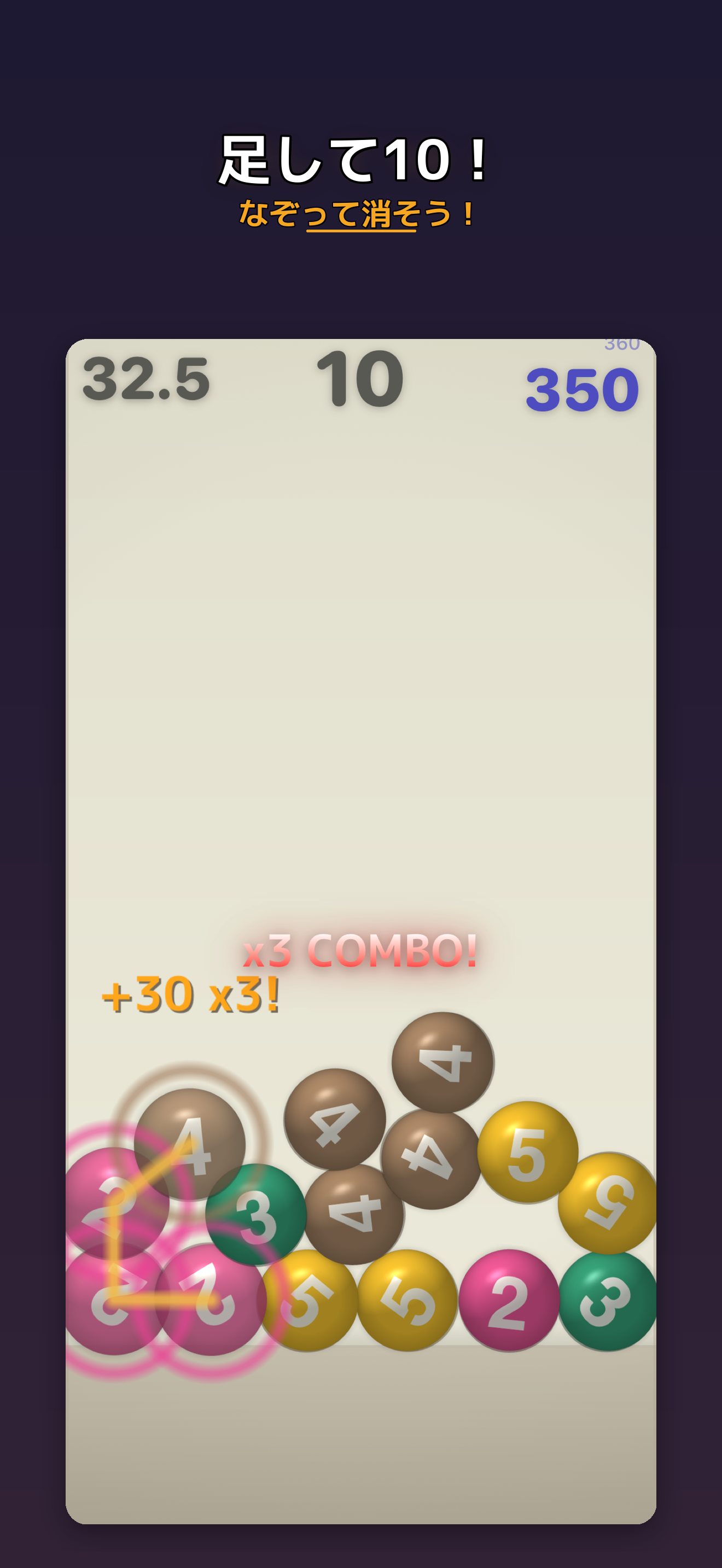
It is not a Tetris-style block-stacking game. It is not Puyo Puyo’s four-of-a-color system either.
But it lives near the same pleasure:
- numbered balls fall
- you scan the board
- you find combinations
- you make 10
- balls clear
- chains and combos feel good
In that sense, Tashitama takes the falling puzzle loop and bends it toward number sense.
The goal is not to make arithmetic difficult. The goal is to make the moment of making 10 happen quickly, repeatedly, and satisfyingly.
Falling puzzle games are games about restoring order
If you trace the origin of falling puzzle games, Tetris sits near the center.
But the wider history shows that the genre was never only one shape.
- Tetris: arrange shapes and clear lines
- Columns: match colors and clear jewels
- Dr. Mario: match colors and clear viruses
- Puyo Puyo: connect colors and build chains
- Tashitama: add numbers and clear totals of 10
The shared idea is simple: look at a messy board, find a condition, clear something, and make the situation a little more orderly.
Falling puzzle games are not just busy games.
They are games about turning confusion into a little bit of order.
That is why they feel good.
And that is why people keep coming back.
If you want to dig into why making 10 feels so natural, read Why Do Humans Use Base 10? The Answer Goes Beyond “Because We Have 10 Fingers”.
References
- The Tetris Company: About Tetris
- Britannica: Tetris
- Sega Retro: Columns
- Nintendo: Dr. Mario
- SEGA: Puyo Puyo Portal
- SEGA: Puyo Puyo Series Information
Tashitama
Turn the feeling of making 10 into a puzzle.
Tashitama is a quick number puzzle where you trace falling balls, make totals of 10, and chase satisfying chain combos.