Why 3-Player Games Feel Completely Different
Rock-paper-scissors. Chess. Checkers. Othello.
Most competitive games are designed for two players. One enemy. One target. Simple — and that simplicity allows for enormous depth.
But add one more player, and the nature of the game changes entirely.
Not because there are more people. Because the structure of every decision becomes fundamentally different.
In a 2-player game, anything bad for your opponent is good for you. The moment a third player joins, that logic breaks down.
Attack one player, and the other benefits. Play defensively, and the other two close in. Make the objectively strongest move, and somehow finish last.
This article explores what makes 3-player games so different — and why that difference is what makes them fascinating.
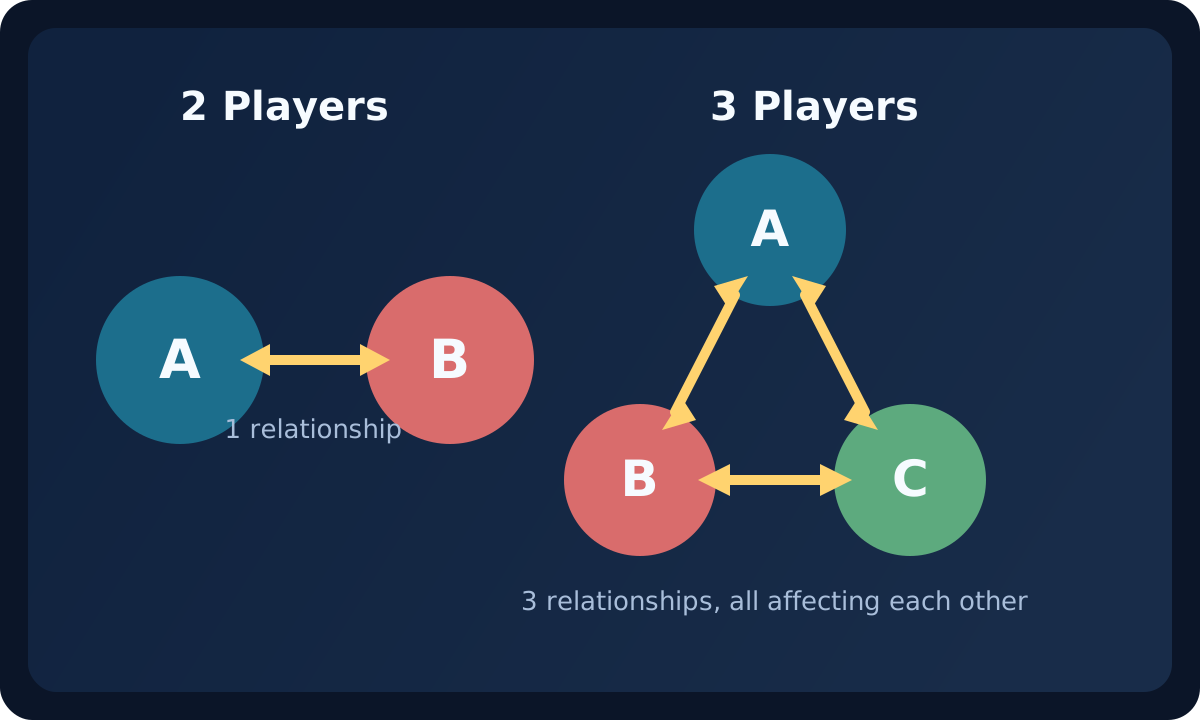
In 2-Player Games, the World Is Binary
Let’s start with what makes 2-player games clean.
In a 2-player game, every situation reduces to you vs. them.
- If your opponent loses ground, you gain it
- Your best move is their worst move
- The outcome is decided between two parties
This is called a zero-sum game, and it has a beautiful mathematical symmetry. Centuries of chess and shogi research have been built on this clarity.
The 2-player world is simple. One enemy. One relationship to manage.
The Moment a Third Player Joins, Relationships Triple
With three players, relationships multiply instantly.
A 2-player game has one relationship (A and B).
A 3-player game has three:
- A and B
- B and C
- A and C
And these three relationships are not independent. When A attacks B, C gains an advantage. Every action ripples through all three relationships simultaneously.
This is the source of what makes 3-player games unique.
Every move you make affects not just the player you’re targeting, but also the one you’re not. You are always playing a direct game and an indirect game at the same time.
The “Best Move” Might Not Exist
In 2-player games, the concept of an optimal move is well-defined. Maximize your advantage, minimize your opponent’s. Game theory provides clean answers.
In 3-player games, even defining the best move becomes mathematically difficult.
This has been a topic in game theory for decades. The minimax theorem works elegantly for 2-player zero-sum games, but with three or more players, equilibria become complex and the uncertainty of “who will do what” becomes fundamentally irreducible.
In practical terms:
- With 2 players, you read one opponent’s best move
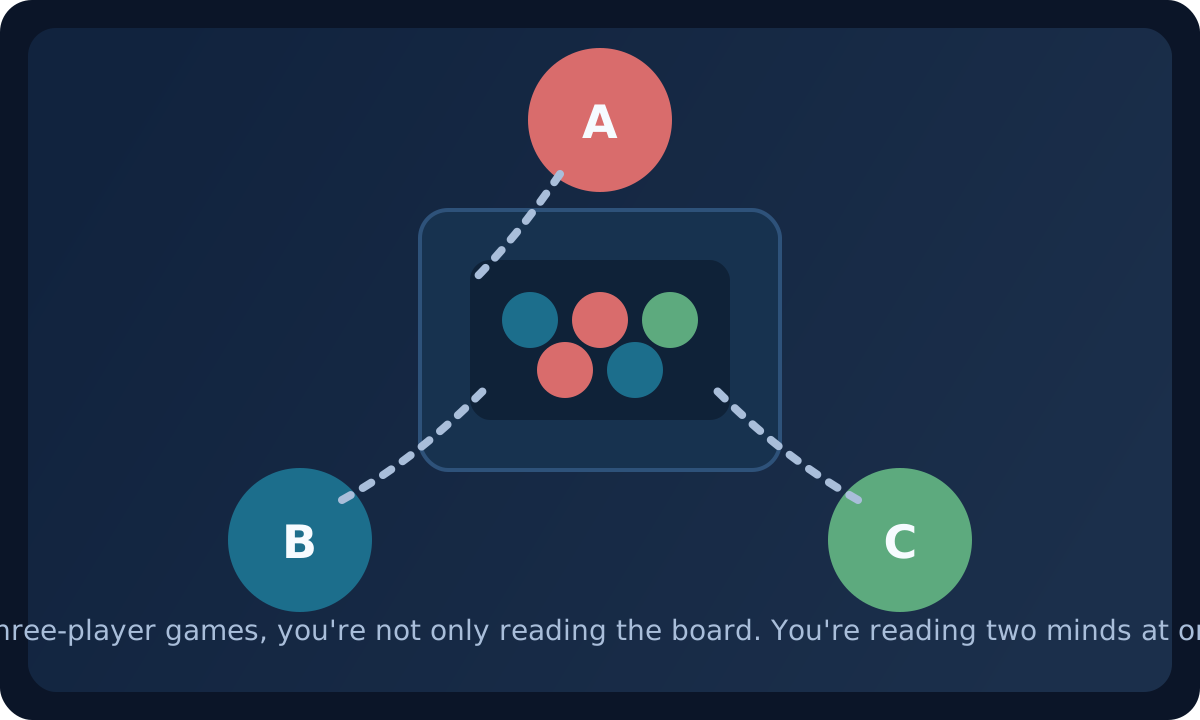
- With 3 players, you read two opponents — who are also reading each other
- Their decisions are interdependent
So 3-player games introduce an inherent uncertainty that 2-player games don’t have.
That’s not a flaw. It’s what makes them a deeper test of human judgment.
Alliances Form Naturally. So Does Betrayal
One of the most fascinating phenomena in 3-player games is implicit alliances and inevitable betrayal.
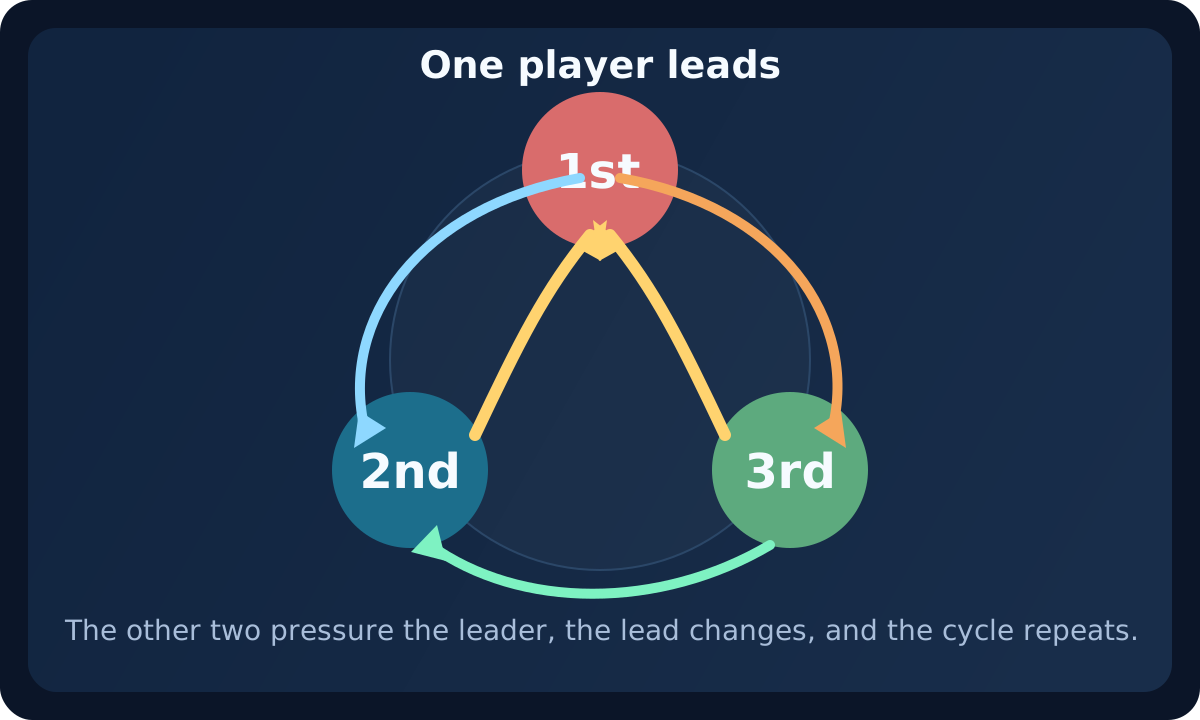
When one player pulls ahead, the other two naturally gang up. No one needs to say “let’s team up” — it happens structurally.
- Attacking the leader benefits both trailing players
- So pressure on the leader concentrates automatically
- The lead changes hands
- The new leader gets targeted instead
This automatic balancing doesn’t exist in 2-player games.
But alliances have another side. They can’t last forever. Eventually, someone has to win. So when to break the alliance becomes a critical decision.
That moment — when cooperation turns to competition — is the unique thrill of 3-player games.
Reading the Room Becomes Part of the Game
In 2-player games, reading the board is enough. Analyze your opponent’s position logically, find the best move. Emotions are noise.
In 3-player games, reading the other two players’ intentions and emotions directly affects the outcome.
- Who does that player think is their main rival right now?
- If I make this move, how will the third player react?
- Should I stay quiet so I don’t become the target?
This is different from the logical analysis of chess. It’s social reading — predicting intentions and reading relationships.
That’s why you can’t win 3-player games with pure logic. When emotional reads and table dynamics enter the picture, a board game starts to feel like a conversation.
Why So Few Games Are Designed for Exactly Three
By now, 3-player games probably sound appealing.
They are. But here’s the thing: games designed for exactly three players are surprisingly rare.
Most board games and card games are built for 2 players or 4+. Three is treated as an awkward number. Party games shine with four or more. Competitive games balance best as 1v1.
Three is genuinely hard to design for.
But in everyday life, three-person moments happen all the time.
A family of three. Three friends hanging out. Three people at dinner. A quiet moment during a trip with three people.
“There are plenty of 2-player games, but nothing quite fits three.” It’s a small frustration, but a surprisingly common one.
A Game Born at a Family Dinner Table
Reversi Trio was born from exactly that moment.
The developer has a family of three, and kept wishing for a simple game they could play together over dinner. So he built one — originally just for his own family. When extended family gathered and his son played it with a cousin, three players laughing around a screen, it became clear: this experience was worth sharing.
Three-player moments happen in every household. They just needed a game that fits.
If you want to see the app first, you can jump to the Reversi Trio page and come back afterward.
Why 3-Player Reversi Feels Like a Different Game
Reversi (Othello) is a complete, deeply strategic 2-player game. Simple rules, profound depth.
But with three players, the same rules create an entirely different experience.
- Take a corner, and the third player grabs the edge
- Capture too many pieces, and two players sandwich you
- Lead early, and you become the target
- Attack one player, and the other quietly benefits
Established 2-player strategies stop working. Going from reading one opponent to reading two changes the quality of the game itself.
It doesn’t just become more complex. It becomes more human.
Summary
2-player games are about outplaying your opponent.
3-player games are about reading relationships.
- Three relationships instead of one
- Implicit alliances and inevitable betrayal
- Social reading shapes the outcome
- The “best move” may not even exist
That’s why 3-player games aren’t an extension of 2-player games. They’re practically a different genre.
And the appeal runs deeper than game theory. It connects to something very human: wanting to enjoy time together when there happen to be three of you.
If you’re curious about what Reversi feels like with three, try Reversi Trio. Seeing the actual board makes the “this is not just 2-player with one extra person” idea click much faster.