How Wakeikoku Was Made
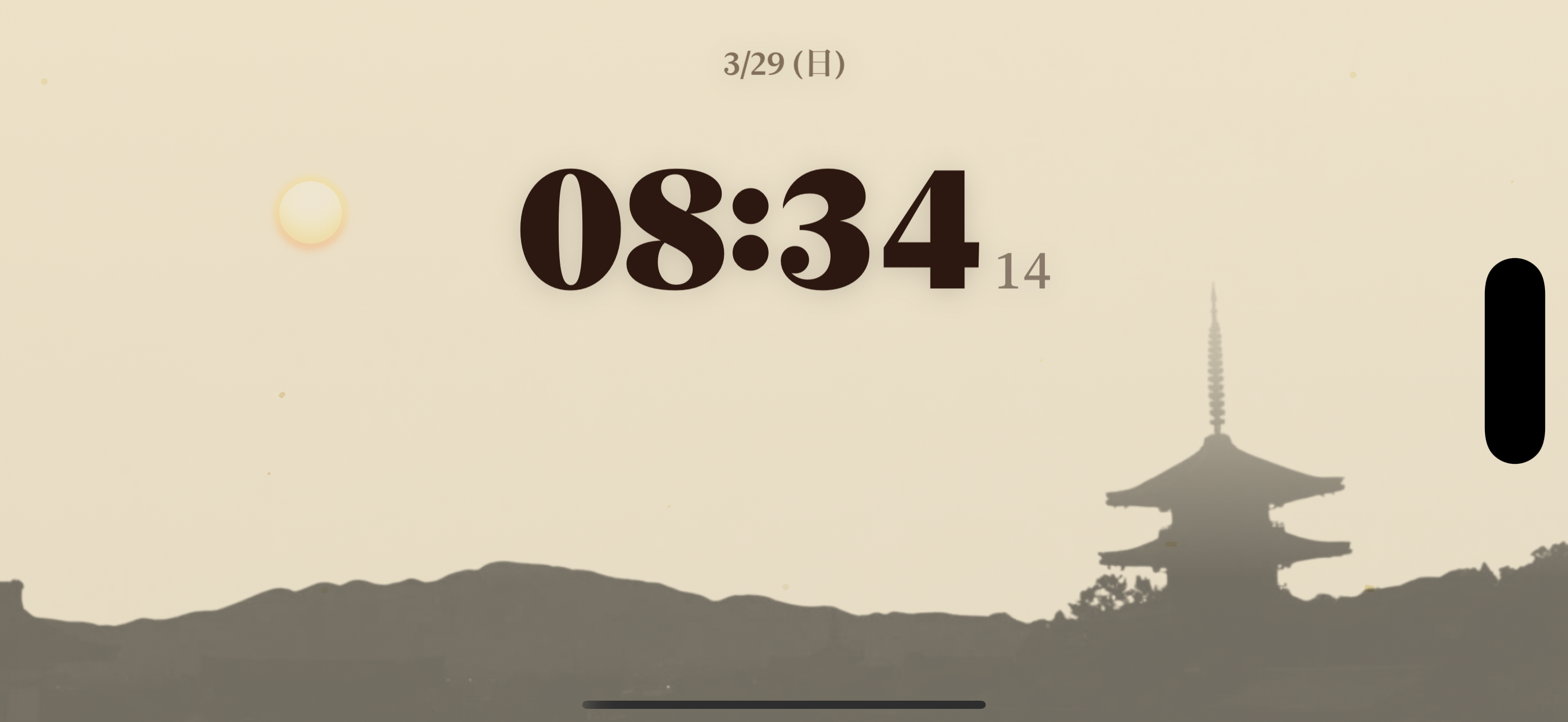
Wakeikoku is a landscape desk clock app for iPhone where Japanese scenery shifts over time through a world inspired by washi paper and ink painting. This article tells the story behind it: where it started, what kind of feeling it was trying to protect, and why it took this particular shape.
Wakeikoku began not with a grand concept, but with a small discomfort on a desk.
While working, I often kept my iPhone on a charger and used Apple’s built-in clock mode. It was useful. But after seeing it every day, it slowly started to feel flat. Nothing was wrong with it, and yet it was not something I wanted to keep looking at.
If a clock was going to stay in my field of view for hours, I wanted something calmer. Not just vaguely Japanese, but something quieter, deeper, and more complete in its mood. I wanted a clock that felt like the ultimate expression of Japanese atmosphere. That was the real beginning of Wakeikoku.
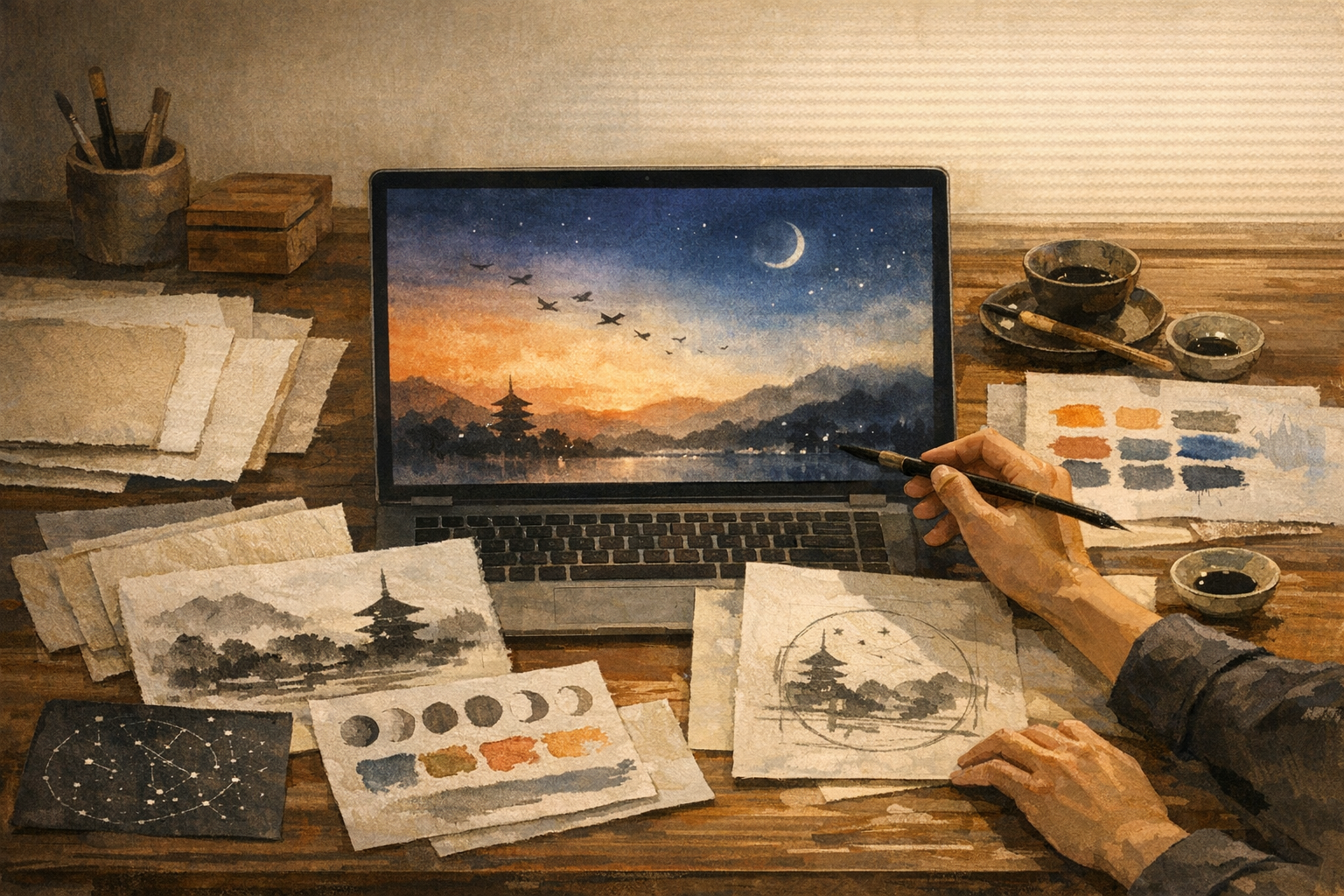
From very early on, I kept thinking about washi. I did not want the screen to feel like a glowing digital panel. I wanted it to feel more like paper, something with texture, something that could sit naturally inside a room instead of pushing itself forward as a device.
But paper alone felt too sparse. Quiet, yes, but not yet deep enough to hold your attention over time. That is when Kyoto entered the picture.
I loved the idea of bringing a Kyoto scene into the app, but I did not want photographic realism. Realistic scenery is strong. Beautiful, but often too busy for something that lives beside you while you work. What I wanted was not a scene that performed for your attention, but a scene that could simply be there, gently and naturally.
That is why ink painting was present from the beginning. Even so, a still ink landscape by itself did not yet feel complete.
At some point, a different thought surfaced: time is not just something that is displayed. It is something that moves.
Morning becomes day. Day becomes evening. Evening becomes night.
That felt like the real core of it. If I was going to make a clock in a Japanese visual language, then time should not be carried only by numbers. The scenery itself should slowly speak the hour. That was when Wakeikoku finally began to take shape.
Color became part of that search too. If the tones were too vivid, the calmness disappeared. If they were too muted, the world lost its living presence. I kept thinking about how far color could seep into washi and ink before the mood broke. I wanted change that felt quiet but unmistakable.
The world began to stand up more clearly when I imagined birds moving through Kyoto’s evening sky. A pagoda, the texture of paper, birds in the fading light, and then stars and moonlight at night. Around that point, Wakeikoku stopped feeling like a Japanese-themed clock and started feeling closer to a hanging scroll with time moving inside it.
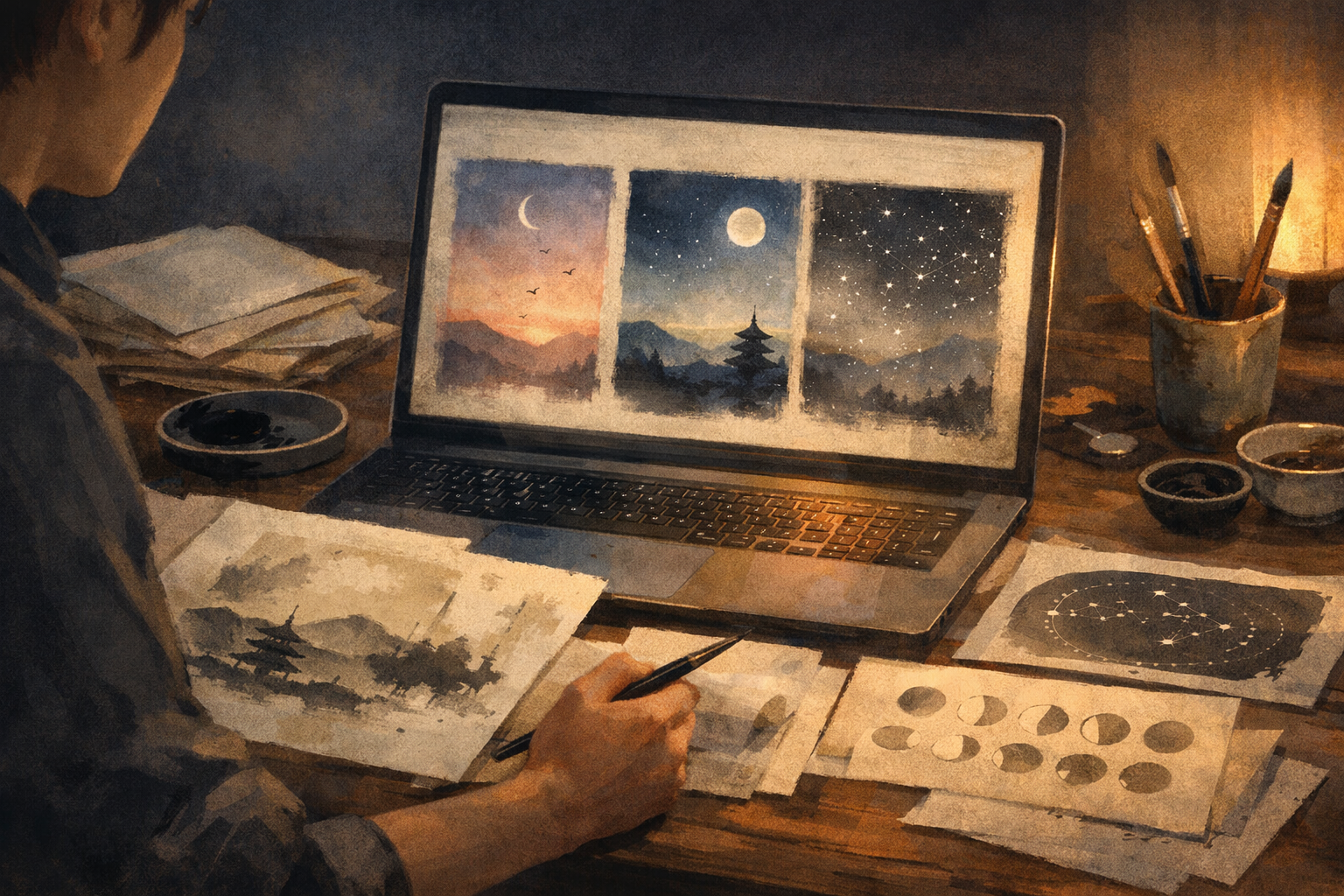
The part that demanded the most care was the sky.
Projecting a starry sky onto a flat screen is not as straightforward as it looks. In a way, it resembles the difficulty of drawing a world map: you are flattening something spherical, so distortions always appear somewhere. Existing techniques helped, but they still needed tuning until the result matched the feeling I wanted.
The moon and the sun were also tricky. Near the horizon, they do not look the same as they do higher in the sky. The color shifts because the atmosphere changes the light, and they can also appear larger because of surrounding comparisons. Simply being technically correct was not enough. On a screen, strict correctness can still look unnatural.
So in the end, what mattered most was not accuracy alone, but whether the scene felt natural when you looked at it. The sky in Wakeikoku stands on a technical base, but it was shaped again and again by a more human question: does this feel like a real quiet scene, or just a calculation?
Wakeikoku was not born mainly from the desire to make a useful clock. It was born from the desire to place something beside work that makes your mind feel a little more settled each time you glance at it.
It started with something small, just a bit of fatigue with Apple’s clock display. But when I followed that feeling far enough, it turned into a wish for washi, for ink, for Kyoto air, and for time itself to feel like something that flows. In that sense, the story of Wakeikoku is less about features than about trying to answer a quiet question: what kind of time do I want to place on my desk?
If this piece makes you imagine what kind of scenery you would want beside you while you work, then you are already very close to the idea that created Wakeikoku.
The Short Version
Wakeikoku began with a small fatigue toward Apple’s clock mode and grew into a desire for a calmer, more deeply Japanese desk clock. From there, the idea expanded into washi textures, ink-painted scenery, Kyoto, and the thought that time should feel like something that moves rather than something merely shown. The result became less like a conventional clock app and more like a small landscape meant to quietly settle the space beside your work.
Common Questions
What is Wakeikoku?
Wakeikoku is a landscape desk clock app for iPhone where Japanese scenery shifts over time through a world inspired by washi paper and ink painting.
Why was Wakeikoku made?
It began with a small sense of fatigue from seeing Apple’s clock mode every day while working, and a desire for a desk clock that felt calmer, quieter, and more deeply Japanese.
What did Wakeikoku focus on most?
The quiet texture of washi and ink, the idea that time should feel like something that moves, and a carefully tuned sky so the moon, stars, and light feel natural rather than merely technical.
If you want to see the app itself and its four worlds, visit Wakeikoku - Ink, Stars & the Flow of Time.