How Many Squats Should Beginners Do? A Simple Way to Start Without Burning Out
When people decide to start squats, this is usually the first question:
How many should I do?
10? 20? 30?
Every day? A few times a week?
It’s a natural question. But there’s one thing worth knowing up front.
For beginners, the most important number is not the perfect number. It’s the number you can keep doing.
This article looks at how many squats beginners should start with if the goal is to build a habit without burning out.
First: 10 is not a magic number
The most important clarification comes first.
There is no universal perfect squat count.
The same bodyweight squat can feel completely different depending on:
- body weight
- current strength
- age
- balance and form
- training background
So it would be inaccurate to say that 10 is scientifically the one correct beginner number.
What is true is this:
around 10 reps is often a practical entry point for habit-building.
It usually leaves enough room to focus on form, avoid a brutal first session, and still feel like tomorrow is possible.
So the real point is:
- 10 is not a magic prescription
- but it is often a useful starting translation of “begin with something repeatable”
What exercise guidelines actually mean when they talk about reps
This is where the topic gets more interesting.
The World Health Organization recommends that adults do muscle-strengthening activities involving major muscle groups on 2 or more days per week. That tells you the health priority: strength work should exist in your week.
The American College of Sports Medicine has also long recommended that novice resistance training often uses loads that allow about 8 to 12 repetitions near fatigue.
But notice what that really means.
These recommendations are not saying that 10 reps is universally best. They are saying that training should match the person and the load.
That becomes tricky with bodyweight squats, because bodyweight is not the same load for everyone. For one beginner, 10 squats may feel demanding. For another, 10 may barely count as work.
That is why beginner squat advice is more useful when translated into:
- Can you keep form?
- Can you repeat it later this week?
- Does it still fit your life?
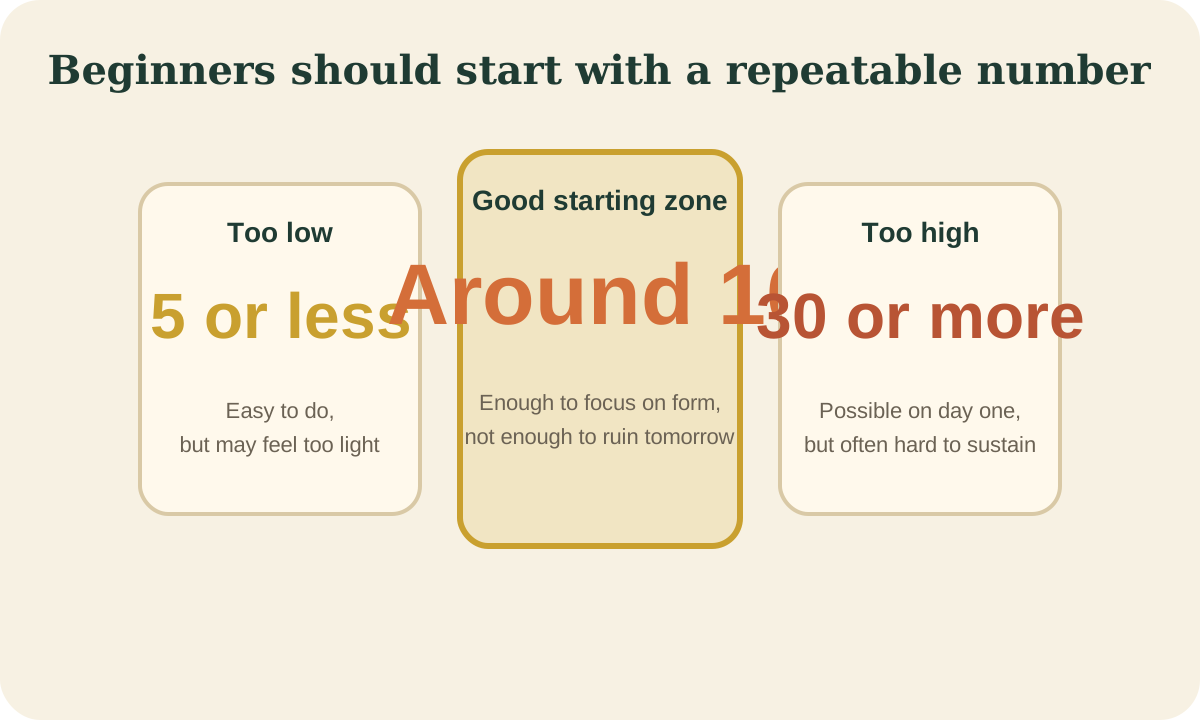
If you start too high, you usually stop fast
Squats are easy to begin. No equipment. No gym. No setup.
That convenience creates a trap: people often choose a number based on enthusiasm instead of sustainability.
- 50 every day from now on
- Maybe 100, just to be serious
- 30 at minimum, otherwise it won’t count
This is where many beginners lose the habit.
At the beginning, discomfort arrives before confidence. Your thighs burn. Your breathing gets rough. The next day you feel soreness. Then “I’ll skip today” quietly appears.
When the number is too high, squats stop feeling like a habit and start feeling like a punishment.
A slightly-too-easy number is usually the right place to begin
For many beginners, around 10 reps is a very practical starting point.
It won’t be perfect for everyone, but it’s a strong baseline because:
- you can still think about form
- it doesn’t wreck your breathing
- it doesn’t make tomorrow feel impossible
- it leaves room to think “I can do this again”
At the beginning, the goal is not to squeeze out maximum effort. It’s to leave enough margin that the next session still feels possible.
Choose your number by sustainability, not by limit
Fitness advice often focuses on what is “effective.”
That matters. But for beginners, the first real problem is not muscle optimization. It’s disappearance.
So instead of asking “what is the hardest number I can survive today?” try asking:
- Can I do this again tomorrow?
- Will I still want to do it three days from now?
- Can I still manage this on a low-energy day?
If the answer is yes, the number is probably good, even if it looks small.
If the answer is no, the number is too high for habit-building, even if it looked impressive on day one.
With bodyweight squats, the same rep count can mean very different things
This is the part many beginners don’t hear clearly enough.
The familiar “8 to 12 reps” idea in strength training usually assumes a load that actually brings you close to fatigue in that range.
But with bodyweight squats, that may or may not be true.
For example, 10 reps may feel very light if you:
- already walk a lot
- have relatively strong legs
- are lighter in body weight
And 10 reps may already feel substantial if you:
- are deconditioned
- find sit-to-stand movements tiring
- lose form quickly when squatting deeper
So the same number can represent completely different training stress.
That is why internet advice about rep counts often feels strangely wrong in real life.
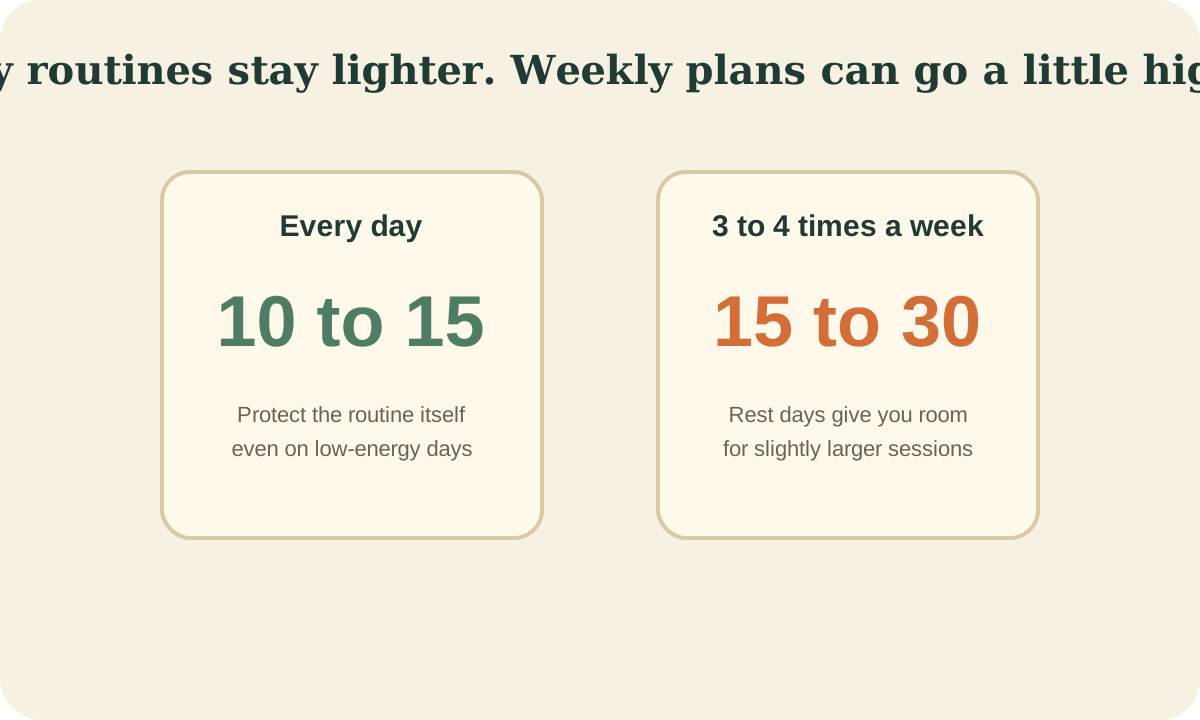
If you’re doing squats every day, go lighter
A lot of beginners want to build a daily routine.
That’s fine. But if you’re going daily, the per-session number should usually stay lower.
A rough way to think about it:
- If you’re going every day: around 10 to 15
- If you’re going 3 to 4 times a week: around 15 to 30
These aren’t hard rules. Age, fitness, recovery, and form all matter. But the principle is useful:
the more often you do it, the lighter each session should probably be at first.
The best signal for beginners is often how tomorrow feels
The right number is not judged only by how hard the set feels in the moment.
For beginners, tomorrow gives you better information.
- Are you sore but still functional?
- Can you move normally?
- Does the idea of doing squats again feel possible instead of awful?
Early habit-building often works best when the session feels meaningful without making the next session emotionally expensive.
In other words, “I felt it, but I can come back” is often a better sign than “I destroyed myself.”
10 reps for 30 days beats 50 reps for 3 days
This part matters more than it seems.
Someone who does 10 squats for 30 days is usually in a much better place than someone who does 50 squats for 3 days and disappears.
Why?
Because squats change your body through repetition, not through one dramatic burst of motivation.
- 10 x 30 days = 300 reps
- 50 x 3 days = 150 reps
And the consistent person is also more likely to improve form, confidence, and routine.
For beginners, the first win is not doing a lot. It’s not vanishing.
Increase the number only when the current one feels clearly comfortable
So when should you add more?
The simplest sign is this:
when your current number feels clearly manageable, and you don’t drag fatigue into the next day.
If 10 feels easy, you can try:
- 12
- 15
- or 2 sets of 10
There’s no need to double the number. Small increases are much more habit-friendly.
Beginners should track more than just reps
Reps are the most visible number, so it’s easy to obsess over them.
But these three questions matter just as much:
1. How many days did I do it this week?
Consistency often matters more than one heroic session.
2. Does the routine still feel sustainable?
If every session feels too painful, the number is probably too high.
3. Am I still avoiding zero on tired days?
Being able to do 10 even on an off day is a powerful sign that the habit is alive.
For beginners, it is often smarter to monitor whether the routine survives than whether the rep count looks impressive.
When in doubt, start low and let your record decide
This is usually the most practical answer of all.
Start with a smaller number. Say 10.
Do it for several days or a week, then look at:
- whether it felt too hard
- how many days you actually kept it going
- whether a small increase feels realistic
That process will usually tell you more than a generic number on the internet.
The right squat count is not something you magically guess on day one. It’s something you adjust while staying consistent.
What to do if 10 feels too easy or too hard
By this point, you might be thinking: what if 10 doesn’t fit me at all?
That’s a normal conclusion.
If 10 feels too easy
- move up to 12 or 15
- do 2 sets instead of 1
- slow the lowering phase
- squat with more control and depth
If 10 feels too hard
- use chair squats
- reduce the range of motion
- start with 5
- do it 3 times a week instead of daily
The real goal is not to match a number you saw online. It is to find a level of effort that stays alive in your real life.
If deciding the number feels messy, use a system that makes progress visible
If you’re thinking, “Even if I choose a number, I’ll probably lose track anyway,” that’s a completely normal problem.
LegScroll is built to auto-count squats while showing:
- what you did today
- whether the streak is still alive
- how your effort accumulates over time
If you want the tracking angle first, If You Can’t Stick With Squats, You May Not Need More Motivation — You May Need Tracking is the companion article.
References
- WHO: Physical activity
- ACSM Position Stand: Progression Models in Resistance Training for Healthy Adults
Summary
Beginners don’t need a huge squat target. They need one they can keep.
- Around 10 reps is a practical starting point for many people
- Sustainability matters more than your maximum effort
- If you go daily, keep each session lighter
- Add more only when the current number feels easy
- Track consistency, not just raw reps
Instead of searching for the perfect number, look for the number that still lets you come back tomorrow. That’s usually the strongest way to begin.